Last updated: 2 September 2026. Icom has published pre-release specs only. Price and delivery date are still unconfirmed. This page changes as Icom releases more.
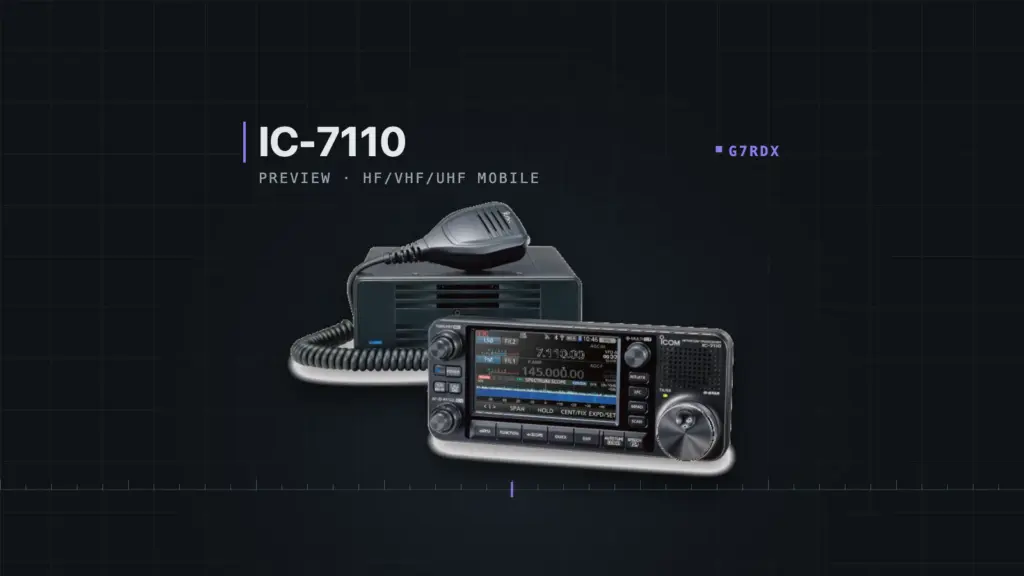
Icom showed the Icom IC-7110 for the first time at Ham Fair Tokyo on 29 August 2026. It is a new all-mode radio for HF, 50, 144 and 430 MHz, and it replaces the IC-7100, a radio Icom has sold since 2013. All-mode means the radio can talk in every common way: voice, Morse code and digital data. The UK and European version adds the 4m band as standard.
Icom has not announced a price or a delivery date. This page collects every confirmed spec and what changed from the IC-7100. It compares the IC-7110 with the IC-705 and Yaesu FT-991A, covers what UK buyers need to know, and lists the questions Icom has not answered yet.
In short. The Icom IC-7110 is a 100 W HF, VHF and UHF radio with a separate control head, announced on 29 August 2026 as the successor to the IC-7100. The big changes are a direct sampling receiver on HF and 6m, two receivers with dualwatch, a 4.3 inch colour touchscreen, Wi-Fi, Bluetooth 5.3, GNSS and USB-C. There is no internal antenna tuner. Price and delivery are unconfirmed as of 2 September 2026. One UK dealer now takes a £250 deposit.
Jump to: What is the Icom IC-7110? · Icom IC-7110 specifications · Does the IC-7110 have two receivers? · What is the IC-7110 display like? · Connectivity: Wi-Fi, Bluetooth 5.3, GNSS and USB-C · Does the IC-7110 support D-STAR? · Decoders, FT8 preset and digital modes · Controller and mobile mounting · Does the IC-7110 have an antenna tuner? · IC-7110 vs IC-7100 vs IC-705 vs FT-991A · Icom IC-7110 UK price, deposits, 4m and licence limits · When is the IC-7110 release date? · What Icom has not confirmed yet · Who should buy the IC-7110, and who should wait? · Frequently asked questions
What is the Icom IC-7110?
The Icom IC-7110 is a 100 W all-mode transceiver with a separate control head. It covers HF, 50 MHz, 144 MHz and 430 MHz, plus 70 MHz on the UK and EU version.
A transceiver is a radio that both listens and talks. The receiver is the part that listens. The transmitter is the part that talks. HF is the short wave range, from 1.8 to 30 MHz, where signals bounce off the sky and reach other countries. VHF (144 MHz, the 2m band) and UHF (430 MHz, the 70cm band) are higher frequencies used for local contacts and repeaters.
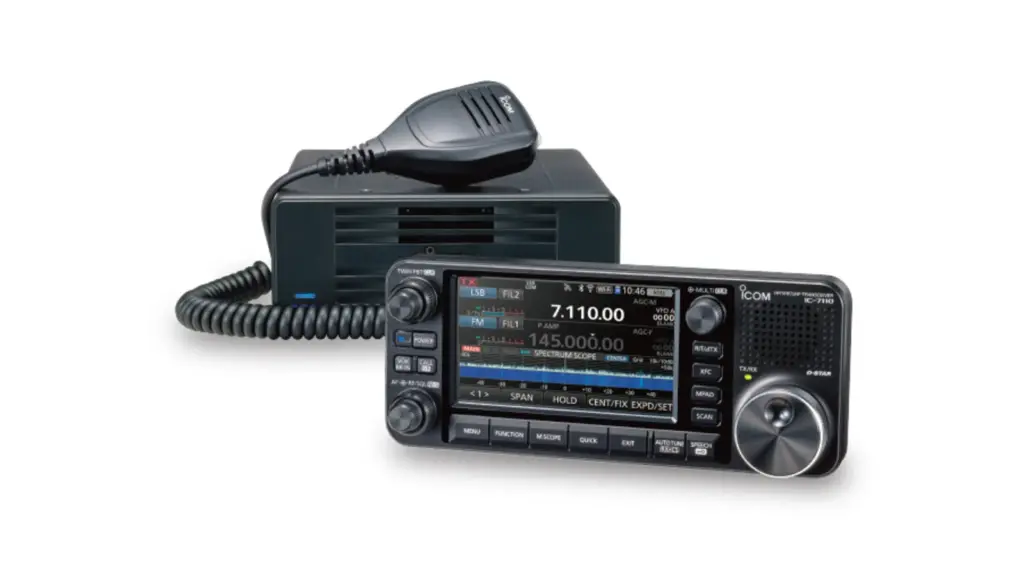
A separate control head means the radio comes in two boxes. The small box has the screen and buttons and sits on your dashboard or desk. The big box holds the electronics and hides under a seat or on a shelf. A cable joins them. The IC-7100 used the same idea, and UK mobile operators liked it. Icom kept the layout and rebuilt everything inside.
Icom announced the radio at the JARL Ham Fair in Tokyo on 29 August 2026. Icom UK confirmed the same day that the model succeeds the IC-7100. The radio was no secret. Icom ran a teaser campaign from April 2026 and showed a mock-up labelled X-026 at Dayton Hamvention, HAM RADIO Friedrichshafen and WRTC 2026. Nobody got specs from those shows. Ham Fair gave the X-026 a name, a spec sheet and a promotional video.
Icom IC-7110 specifications
The Icom IC-7110 gives 100 W on HF and 6m and 50 W on 2m and 70cm. It has two receivers, a 4.3 inch colour touchscreen and built-in Wi-Fi, Bluetooth and GNSS. Icom marks every figure as pre-release and “subject to change before final approval”.
Figures come from Icom UK, Icom Europe and Icom’s pre-release leaflet. Gaps are filled from the Japanese launch coverage (hamlife.jp), cq.sk and RigPix. Cells marked “not yet published” are exactly that. Three table terms need a word. A spectrum scope is a live picture of which frequencies have signals on them. A waterfall is that picture scrolling down over time. GNSS is the satellite positioning system your phone uses.
| Feature | Icom IC-7110 | Icom IC-7100 |
|---|---|---|
| Bands (TX) | HF, 50, 70 (UK/EU), 144, 430 MHz | HF, 50, 70 (UK/EU), 144, 430 MHz |
| RX coverage | 30 kHz to 144 MHz band continuous, including FM broadcast and airband, plus 430 MHz | 30 kHz to 199 MHz, 400 to 470 MHz |
| Modes | SSB, CW, RTTY, AM, FM, D-STAR DV | SSB, CW, RTTY, AM, FM, D-STAR DV |
| Power HF / 50 MHz | 100 W | 100 W |
| Power 70 MHz (UK/EU) | 50 W (early listings, awaiting Icom UK confirmation) | 50 W |
| Power 144 MHz | 50 W | 50 W |
| Power 430 MHz | 50 W | 35 W |
| Receiver | RF direct sampling with FPGA on HF/50 MHz. separate VHF/UHF receiver | Triple conversion superheterodyne with DSP |
| Receivers | Two, independent, with dualwatch | One |
| Display | 4.3 inch colour touchscreen, auto dimming, backlit keys | 3.5 inch monochrome touchscreen |
| Spectrum scope | Real-time spectrum scope and waterfall, audio scope | None |
| Wi-Fi | Built in, 2.4 and 5 GHz | None |
| Bluetooth | Built in, v5.3 | None |
| GNSS/GPS | Built in | External GPS via data socket |
| USB | USB-C on controller and main unit | USB type B |
| Storage | microSD (controller) | SD card |
| Ethernet | Not shown on published connector list | None |
| Antenna sockets | Two SO-239 (HF/50 and 144/430) | One SO-239 |
| Internal ATU | None. Tuner socket for external unit | None |
| Decoders | CW and RTTY decoders | RTTY decoder |
| FT8 | One-touch preset, 3 user-writable preset slots | Manual setup |
| D-STAR | DV, DR mode, Terminal and Access Point mode over Wi-Fi, repeater monitoring, picture transfer | DV, DR mode, Terminal/AP via PC |
| Cooling | Front-mounted fan, aluminium die-cast frame | Internal fan |
| Controller cable | 3.5 m supplied, 5 m optional | 3.5 m supplied |
| Controller mounting | 1/4-20 tripod thread, AMPS pattern, magnet accessory mount | Bracket |
| Controller size (approx.) | 200 x 84 x 36 mm (spec listings). 198 x 83 x 39 mm measured at Ham Fair | 165 x 64 x 79 mm |
| Weight | Not yet published | 2.3 kg main unit, 0.5 kg controller |
| Current drain | Not yet published | 22 A TX max |
| RX sensitivity, selectivity | Not yet published | Published |
Japan gets three power variants: IC-7110 (100 W), IC-7110M (50 W) and IC-7110S (10 to 20 W). Icom UK has only mentioned the full-power version so far, which matches how the IC-7100 was sold here. The SO-239 in the table is the standard round antenna socket found on almost every HF radio.
Does the IC-7110 have two receivers?
Yes. The Icom IC-7110 has two independent receivers, one for HF and 50 MHz and one for 144 and 430 MHz, each on its own antenna socket. Dualwatch means the radio listens on both at the same time and plays both through the speaker.
You can pair HF with 144, HF with 430, 50 with 144, or 50 with 430, with a different mode on each.
This is the biggest change from the IC-7100. The old radio had one receiver. A mobile operator chose between chasing distant stations on 20m and keeping an ear on the local 2m repeater. A repeater is a radio station on a hill that hears your signal and sends it out again so it travels further. The IC-7110 does both at once. Simultaneous DV dualwatch is also listed, so you can monitor a D-STAR repeater while working analogue voice on the other band.
The HF and 6m side uses RF direct sampling with an FPGA. Direct sampling means the radio turns the antenna signal into numbers straight away and does all the filtering in software. An FPGA is a chip that does that number crunching very fast. The IC-7300 and IC-705 use the same family of design. Icom has not said whether the VHF/UHF receiver is also direct sampling or a down-conversion design. Two receivers also mean two antenna leads to the main unit. Plan your mobile cabling with a separate HF antenna and a dual-band VHF/UHF whip.
What is the IC-7110 display like?
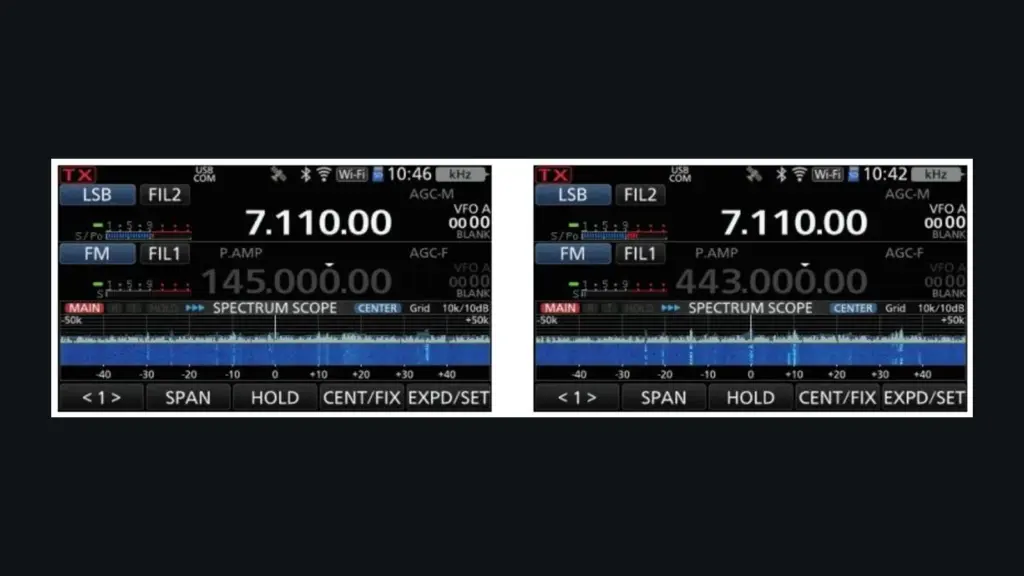
The IC-7110 controller carries a 4.3 inch colour touchscreen with a real-time spectrum scope, waterfall and audio scope. Icom UK says the user interface follows the IC-705, so anyone who has used a 705 or 7300 will feel at home within minutes.
The IC-7100’s 3.5 inch monochrome screen was the most dated part of the old radio. Going to 4.3 inches in colour with a waterfall changes how you operate mobile. You see band activity at a glance instead of tuning blind. The screen dims automatically and the keys are backlit, which matters at night in a car.
Icom fitted the speaker in the controller, on the front upper right, so audio comes from where you are looking. The controller cannot work on its own without the main unit.
Connectivity: Wi-Fi, Bluetooth 5.3, GNSS and USB-C
The IC-7110 has built-in dual-band Wi-Fi (2.4 and 5 GHz), Bluetooth 5.3 and an integrated GNSS receiver. USB-C ports sit on both the controller and the main unit. The IC-7100 had none of these built in.
Wi-Fi handles D-STAR Terminal and Access Point mode, remote operation and firmware updates. Firmware is the software inside the radio, and an update adds features or fixes faults. The radio no longer needs a PC for those jobs. Bluetooth 5.3 pairs a headset or hands-free kit and links to a phone or PC. GNSS gives position for D-STAR and builds a nearest-repeater list as you drive.
Ethernet is the open question. Ethernet is the wired network socket you find on a home router. One European report mentions an Ethernet connection. Icom’s published connector list for the main unit shows no LAN jack. Until Icom clarifies, treat remote-head-over-network as unconfirmed. Assume RS-BA1 style remote control runs over Wi-Fi or USB. RS-BA1 is Icom’s software for running a radio from another room or town over a network.
Does the IC-7110 support D-STAR?
Yes. The Icom IC-7110 supports D-STAR DV with DR mode, Terminal and Access Point mode over built-in Wi-Fi, and DV repeater monitoring. It sends and views pictures on the radio without external devices.
D-STAR is Icom’s digital voice system. It turns your voice into data, sends it over the air or the internet, and turns it back into voice at the far end. DV means digital voice. DR mode is the menu that lists nearby D-STAR repeaters and lets you pick one with a tap. The built-in GNSS feeds that list.
Terminal mode connects the radio straight to the internet. You reach a D-STAR reflector from home with no repeater or hotspot in between. A reflector is an internet server where many D-STAR users meet and talk. Access Point mode turns the IC-7110 into a hotspot for a handheld like the ID-52. A hotspot is a small box that links a radio to the internet.
For UK users this removes the external GPS puck and the PC that the IC-7100 needed for Terminal mode. D-STAR repeater and reflector details for the UK sit on the UK Repeater Network directory. I run a Pi-Star hotspot for my own D-STAR work, and I will test whether the IC-7110’s Terminal mode makes the hotspot redundant once I get my hands on one.
Decoders, FT8 preset and digital modes
The IC-7110 includes a CW decoder and an RTTY decoder on screen. It also has a one-touch FT8 preset with three further user-writable preset slots. A decoder reads a signal and prints the words on the screen, so you can follow Morse code (CW) or radio teletype (RTTY) without learning them by ear. The CW decoder reads Latin and Japanese wabun characters, with adjustable speed and sensitivity.
FT8 is a digital mode where a computer sends short bursts of data that cross the world on tiny power. The FT8 preset does not run FT8 inside the radio. You still need WSJT-X or JTDX on a computer. The preset sets mode, filter, USB audio and CI-V in one press so the radio is ready for the software. CI-V is Icom’s control language, the commands a computer uses to change frequency and mode on the radio. If you have fought with the IC-7100’s data-mode menus and audio levels, you will understand why this matters. The spare slots take SSTV or whatever mode you use most.
Digital modes on Linux with Icom radios work through the USB CI-V and audio interface. Icom has not published the IC-7110 CI-V address or command set yet. Hamlib, the free library that lets Linux programs control radios, will add the IC-7110 once they are public, as happened with the IC-705. For the software side, see the best ham radio software guide and the Digital category.
Controller and mobile mounting
The IC-7110 controller is a slanted head with a built-in speaker, a 1/4-20 tripod thread, an AMPS hole pattern and a magnet mount for accessories. A 3.5 m cable (5 m optional) connects it to the main unit. The main unit measures roughly 168 x 58 x 240 mm, measured at Ham Fair by hamlife.jp, close to the IC-7100 main unit at 167 x 58 x 225 mm.
Those mounting options are a quiet but useful upgrade. A 1/4-20 thread is the screw fitting found under every camera, so any tripod or ball head holds the controller in a car or on a table. The AMPS pattern is a standard set of four screw holes that fits RAM mounts and most mobile brackets. The microphone and keyer jacks are on the controller, so only power, antennas and the controller cable run to the main unit.
The main unit has a front-mounted fan and an aluminium die-cast frame. Front venting suits under-seat installs where the rear sits against a bulkhead. Nobody will know fan noise until units ship.
Does the IC-7110 have an antenna tuner?
No. The IC-7110 has no internal antenna tuner. The rear panel carries a tuner socket for an external Icom unit, and Icom showed the AH-6 alongside the X-026 at Hamvention.
An antenna tuner, or ATU, is a box that adjusts the radio to suit an antenna that is not quite the right length for the band. Without one, a poorly matched antenna sends power back into the radio, and the radio turns its output down to protect itself.
This is the loudest complaint in the forums. The FT-991A includes a tuner. Icom’s answer, going back to the IC-7000 and IC-7100, is that a tuner adds heat and volume to a box meant to hide under a seat. For a mobile whip with a matching coil you do not need a tuner. For a long wire or a multi-band dipole, which are not the right length for every band, you do.
Your options are the Icom AH-6 or AH-4 remote tuners, which mount at the antenna feedpoint and tune automatically from the radio. A third-party unit such as an LDG AT-200Pro II or Z-100Plus works with an Icom interface cable. A separate guide on IC-7110 tuner options will follow once Icom confirms which AH models are supported.
IC-7110 vs IC-7100 vs IC-705 vs FT-991A
The IC-7110 sits between the IC-705 (a small portable radio) and the IC-7300MK2 (an HF radio for the desk) in Icom’s range. It competes directly with the Yaesu FT-991A as an all-band mobile or shack-in-a-box radio, meaning one radio that covers every band you are likely to use.
Here is how the four compare on the figures published so far. Superhet, short for superheterodyne, is the older receiver design that shifts the signal down in steps before turning it into numbers. C4FM is Yaesu’s digital voice system, and it does not talk to D-STAR.
| IC-7110 | IC-7100 | IC-705 | FT-991A | |
|---|---|---|---|---|
| Layout | Separate head | Separate head | One piece, portable | One piece |
| Power HF/6m | 100 W | 100 W | 10 W (5 W on battery) | 100 W |
| Power 2m / 70cm | 50 / 50 W | 50 / 35 W | 10 / 10 W | 50 / 50 W |
| 4m (UK/EU) | Yes | Yes | No | No |
| Receivers | Two, dualwatch | One | One | One |
| Receiver type | Direct sampling (HF/6m) | Superhet + DSP | Direct sampling below 25 MHz | Superhet + DSP |
| Display | 4.3in colour touch | 3.5in mono touch | 4.3in colour touch | 3.5in colour touch |
| Spectrum scope | Yes, waterfall | No | Yes, waterfall | Yes |
| Internal ATU | No | No | No | Yes (HF/6m) |
| D-STAR | Yes | Yes | Yes | No (C4FM) |
| Wi-Fi / Bluetooth / GPS | Yes / 5.3 / Yes | No / No / External | Yes / Yes / Yes | No / No / No |
| USB | USB-C | USB-B | Micro USB | USB-B |
| Head works stand-alone | No | No | n/a | n/a |
| Launched | 2026 (pre-release) | 2013 | 2020 | 2016 |
Against the IC-7100 the upgrade is total: colour screen, waterfall, second receiver, direct sampling, wireless everything, more power on 70cm. Against the IC-705 the IC-7110 is the 100 W mobile sibling with the same interface. Against the FT-991A you trade the internal tuner for a second receiver, D-STAR, Wi-Fi and a bigger screen.
Yaesu’s newer FTX-1 deserves a mention. The FTX-1 Field is a complete 10 W portable radio. Docking it onto the SPA-1 amplifier makes the 100 W FTX-1 Optima, which in the UK also covers 4m at 50 W. The IC-7110 head does nothing without the main unit, but answers with a single cable install and two receivers. Pick by how you operate: portable-first, FTX-1. Mobile and shack, IC-7110.
Icom IC-7110 UK price, deposits, 4m and licence limits
Icom has not announced a UK price for the Icom IC-7110. Icom UK stated on 29 August 2026 that it has “no confirmed details regarding production, pricing or delivery”. Any price you see on a UK dealer page today is a placeholder.
For a reference point, the IC-7100 carries a UK RRP of £1,299 and sells today at around £900 to £1,000 at Martin Lynch & Sons and Radioworld. Ham Radio Outlet in the USA lists it at $939.95 (on offer at $839.95 in September 2026). RRP is the recommended retail price, the figure the maker suggests and shops often undercut. A successor with two receivers, a colour screen and built-in wireless will not be cheaper. The best guess on this page, not a fact, is a UK launch price above the IC-7100 and below the IC-7300 plus IC-9700 pair, so somewhere in the £1,300 to £1,700 bracket. This paragraph will be replaced with the RRP the day Icom publishes one.
Deposits have started. On 2 September 2026 Martin Lynch & Sons listed the IC-7110 as a “Pre-Order Deposit” at £250, marked “Final Price and Delivery TBC”. The page adds that “final pricing and full specifications will be released by Japan soon”. LAMCO had a listing with no price and an “email when in stock” button. The other UK dealers to watch, Nevada Radio, Waters & Stanton, Radioworld UK and Moonraker, had no listing on the same date. Ham Radio Outlet in the USA takes a refundable $35 reservation, and GigaParts runs a stock alert with no deposit. Read the dealer’s refund terms before paying any deposit, because the final price is unknown.
The UK and EU version includes 70 MHz (4m) as standard, with early listings showing 50 W. All three UK licence classes have access to 4m. Under the Ofcom amateur licence rules in force since 2024, Foundation holders are limited to 25 W and Intermediate holders to 100 W. A Foundation licensee will run the IC-7110 with the RF power control turned down. Full licensees get 1 kW on the main HF, 6m and 2m bands but 160 W on 4m. The RSGB band plans list the UK 4m allocation as 70.0 to 70.5 MHz.
When is the IC-7110 release date?
As of 2 September 2026 Icom has not announced a release date for the IC-7110 in any market. The Japanese press expects domestic sales around the end of 2026 or early 2027, and that is an estimate, not a commitment.
Icom staff at Ham Fair told Japanese reporters that mass-production preparation is under way at the Wakayama factory. RigPix lists the year as “Japan, 2027?”, question mark included.
UK and EU deliveries depend on regional approvals. Icom’s leaflet states the radio “has not been approved by the appropriate authorities in each country”. Icom’s recent pattern helps as a guide. The IC-705 was announced in August 2019 and reached UK dealers in mid 2020. The IC-905 took about a year from reveal to UK shelves. A UK IC-7110 in the first half of 2027 is a reasonable working assumption. This section will be updated as soon as Icom UK gives a date.
What Icom has not confirmed yet
Still unknown on 2 September 2026. Price in any currency. Delivery date in any market. Weight and current drain. Receiver sensitivity, selectivity and frequency stability. Whether the VHF/UHF receiver is direct sampling. Whether there is an Ethernet port. RS-BA1 remote support and the CI-V address. DPD (digital pre-distortion, a trick that cleans up the transmitted signal). Which external tuners are supported. 4m output power on the UK model. Fan noise and real-world receiver performance.
Items come off this list as Icom publishes them, and the “last updated” line at the top of the page changes each time.
Who should buy the IC-7110, and who should wait?
If you run an IC-7100 in a car or a caravan, the IC-7110 is the upgrade you have waited 13 years for. The second receiver alone justifies a look. If you want one radio for a small shack covering 160m to 70cm with D-STAR and a waterfall, this is the only current 100 W Icom that does all of it.
Wait if you need an internal tuner and never use digital voice: the FT-991A does that today at a known price. Wait if you operate portable first: the IC-705 or the FTX-1 suit a rucksack better than a two-box 100 W radio. And everyone should wait for a price and a shipping date before selling anything to fund one.
I plan to put the IC-7110 through FT8 on 2m and 70cm in the RSGB activity contests, where I enter with the IC-9700, and to test the D-STAR Terminal mode against my Pi-Star hotspot. Check the Propagation Score and the Contest Calendar to plan your own first outings once the radio lands.
Questions about the IC-7110? Leave a comment below, or find me on QRZ, Facebook (facebook.com/G7RDX) and YouTube (@g7rdx). The best questions will go into the FAQ.
73 de G7RDX
Frequently asked questions
What is the Icom IC-7110?
The Icom IC-7110 is an all-mode HF, 50, 144 and 430 MHz transceiver with a separate control head, announced by Icom at Ham Fair Tokyo on 29 August 2026 as the successor to the IC-7100. The UK and EU version adds 70 MHz. Output is 100 W on HF and 6m and 50 W on 2m and 70cm.
Is the IC-7110 the successor to the IC-7100?
Yes. Icom UK confirmed on 29 August 2026 that the IC-7110 succeeds the IC-7100, which Icom launched in 2013. The IC-7110 keeps the separable controller layout and adds a colour touchscreen, two receivers, a direct sampling HF receiver and built-in Wi-Fi, Bluetooth and GNSS.
What was the Icom X-026?
X-026 was the development code Icom used for the IC-7110 before the launch. Icom showed an X-026 mock-up with no specifications at Dayton Hamvention, HAM RADIO Friedrichshafen and WRTC 2026, then revealed the production model as the IC-7110 at Ham Fair Tokyo on 29 August 2026.
When will the IC-7110 be released?
Icom has not announced an IC-7110 release date as of 2 September 2026. Japanese press reports based on Icom staff comments point to domestic sales around the end of 2026 or early 2027. UK and EU deliveries depend on regional approval and are likely to follow Japan, so the first half of 2027 is a working estimate.
How much will the Icom IC-7110 cost in the UK?
Icom has not published an IC-7110 price in any currency as of 2 September 2026. The IC-7100 it replaces has a UK RRP of £1,299 and sells at around £900 to £1,000 in September 2026. A launch price above the IC-7100 is expected given the second receiver, colour screen and built-in wireless, but no figure is official.
Can I pre-order the IC-7110 in the UK?
Yes, with a deposit at one dealer. On 2 September 2026 Martin Lynch & Sons listed the IC-7110 as a £250 pre-order deposit with final price and delivery marked TBC. LAMCO listed the radio with an “email when in stock” option and no price. In the USA, Ham Radio Outlet takes a refundable $35 reservation. Check Icom UK’s dealer list for updates.
Does the IC-7110 cover 4m (70 MHz)?
Yes, the IC-7110 covers 4m on the UK and European version, where Icom UK says the band is included as standard. Early spec listings show 50 W output on 70 MHz, the same as the IC-7100. The US version does not include 4m because the band is not allocated to amateurs there.
Does the IC-7110 have an internal antenna tuner?
No. The IC-7110 has no built-in ATU. The rear panel carries a tuner socket for an external Icom unit such as the AH-6 or AH-4, and third-party tuners with an Icom interface cable also work. Icom has not yet published the list of supported tuner models.
Does the IC-7110 have two receivers?
Yes. The IC-7110 has independent receivers for HF/50 MHz and 144/430 MHz, each with its own antenna socket. Dualwatch lets you receive HF or 6m on one receiver while monitoring 2m or 70cm on the other, with different modes on each, including simultaneous D-STAR DV dualwatch.
Is the IC-7110 a direct sampling SDR?
On HF and 50 MHz, yes. Icom’s IC-7110 spec sheet lists RF direct sampling with an FPGA for the HF and 6m receiver, the same approach as the IC-7300 and IC-705. Icom has not stated whether the 144/430 MHz receiver is direct sampling or a down-conversion design.
Does the IC-7110 support D-STAR?
Yes. The IC-7110 supports D-STAR DV with DR mode, Terminal and Access Point mode over its built-in Wi-Fi, DV repeater monitoring and picture transmission. The built-in GNSS receiver builds a nearest-repeater list automatically, with no external GPS needed. Terminal mode over Wi-Fi means no PC or hotspot is needed to reach a reflector.
What connectivity does the IC-7110 have?
The IC-7110 has built-in dual-band Wi-Fi (2.4 and 5 GHz), Bluetooth 5.3, an integrated GNSS receiver, USB-C ports on the controller and the main unit, and a microSD slot in the controller. Icom’s published connector list shows no Ethernet port, although one European report mentions one. Treat Ethernet as unconfirmed.
How big is the IC-7110 display?
The IC-7110 controller has a 4.3 inch colour touchscreen with a real-time spectrum scope, waterfall and audio scope, automatic brightness and backlit keys. The IC-7100 used a 3.5 inch monochrome touchscreen with no scope. Icom says the user interface follows the IC-705.
How does the IC-7110 compare with the Yaesu FT-991A?
The IC-7110 and the FT-991A both give 100 W on HF and 6m and 50 W on 2m and 70cm. The FT-991A is a one-piece radio with an internal HF tuner and C4FM digital voice. The IC-7110 has a separate head, two receivers with dualwatch, D-STAR, built-in Wi-Fi, Bluetooth and GNSS, a 4.3 inch screen, and no internal tuner.
Can a UK Foundation licence holder use the IC-7110?
Yes. The IC-7110 outputs 100 W, so a Foundation licensee sets the RF power control to stay within the 25 W limit set by Ofcom since 2024. Intermediate holders are limited to 100 W, and Full licence holders to 1 kW on the main HF, 6m and 2m bands and 160 W on 4m. All three classes have access to 4m.