Last updated: 2 September 2026. Prices checked at UK dealers on this date. Firmware 1.50 is current.
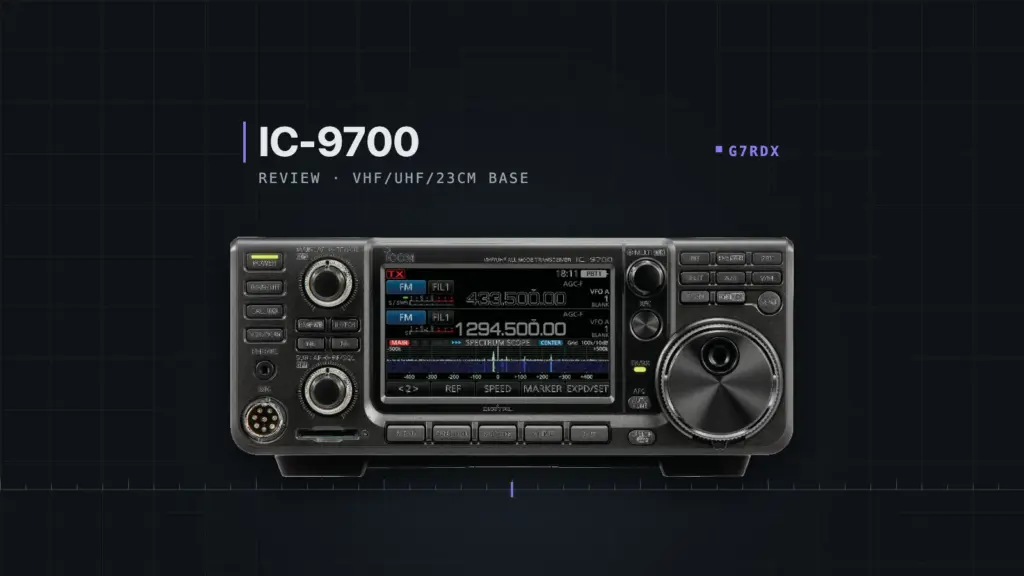
The Icom IC-9700 is a three-band base station transceiver for 2m, 70cm and 23cm. A transceiver is a radio that both talks and listens. It gives 100 W on 144 MHz, 75 W on 430 MHz and 10 W on 1240 MHz. The receiver uses direct sampling on 2m and 70cm, and down-conversion on 23cm. The front has a 4.3 inch colour touch screen with a spectrum scope and a waterfall. On 2 September 2026 it costs £1,899.95 new in the UK.
I own an IC-9700 and use it to win VHF and UHF FT8 contests. It took first place in the UK in the May 2026 RSGB 144 MHz FT8 Activity Contest. It took first in the Restricted section of the June 2026 432 MHz FT8 AC. Seven years after launch, no other radio on sale has those three bands, two receivers and a scope in one box.
In short. The Icom IC-9700 is a 144, 430 and 1240 MHz all-mode SDR transceiver with 100 W on 2m, 75 W on 70cm and 10 W on 23cm, two independent receivers, full duplex satellite mode and D-STAR. UK street price in September 2026 is £1,899.95 new and £1,300 to £1,600 used. No successor has been announced. Buy it for VHF/UHF contesting, EME, satellites and 23cm. Skip it if you never leave 2m FM.
Jump to: What is the Icom IC-9700? · What are the specifications of the Icom IC-9700? · How good is the IC-9700 receiver? Sherwood’s numbers · Two receivers, dualwatch and full duplex explained · FT8 on the IC-9700: the settings that win RSGB contests · Frequency stability and the 23cm drift issue · Satellite operation with the IC-9700 · 23cm in the UK: what you get with 10 W · D-STAR on the IC-9700 · IC-9700 firmware history · Known issues owners report · Icom or Yaesu? IC-9700 vs FT-991A vs IC-905 vs IC-7110 · Icom IC-9700 price in the UK, used values and where to buy · Is there an IC-9700 successor? · Should you buy the Icom IC-9700, and who should wait? · Frequently asked questions
What is the Icom IC-9700?
The Icom IC-9700 is a VHF, UHF and 1.2 GHz all-mode base station transceiver. It launched in early 2019 as the successor to the IC-9100 for operators who do not need HF.
Amateurs call the 144 MHz band “2m”, the 430 MHz band “70cm” and the 1240 MHz band “23cm”, after the length of the waves. All-mode means voice, Morse code and computer modes, not only FM.
The UK version covers 144 to 146 MHz, 430 to 440 MHz and 1240 to 1300 MHz. It works in SSB, CW, RTTY, AM, FM and the D-STAR modes DV and DD. SSB is the voice mode used for long distance. CW is Morse code. D-STAR is Icom’s digital voice system, explained further down.
The receiver is the part that listens. On 2m and 70cm it uses RF direct sampling. The signal from the antenna goes straight into a chip that turns it into numbers, and software does the rest. This is the IC-7300 design, so the IC-9700 is an SDR, a software defined radio. On 23cm the signal is first shifted down to a lower frequency, then turned into numbers. That is down-conversion.
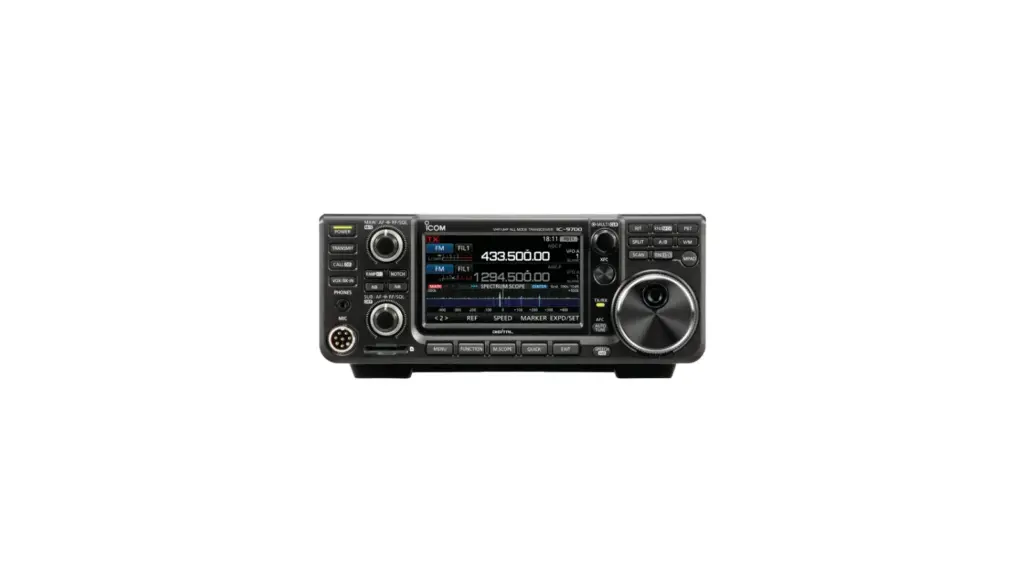
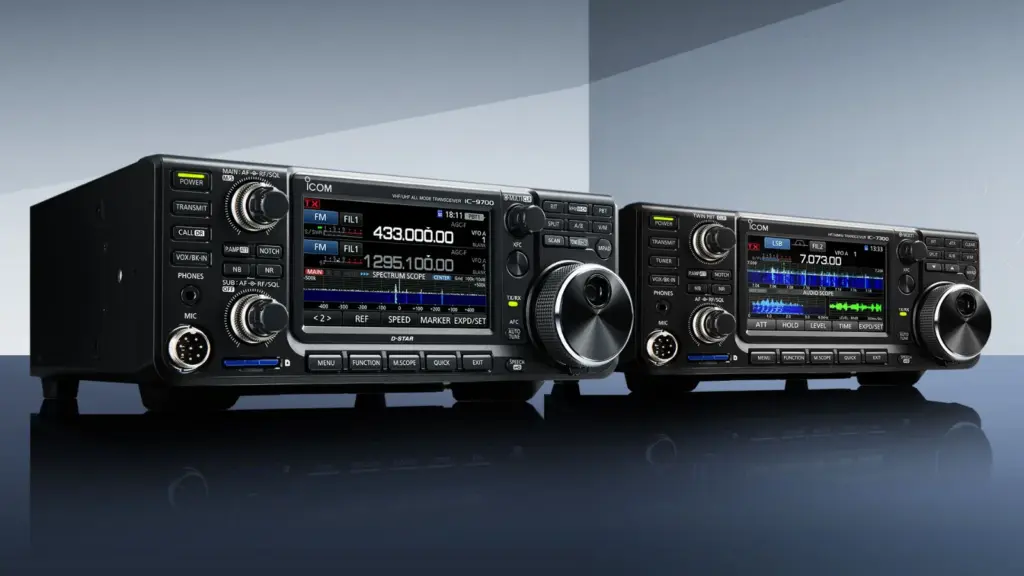
The front panel is the IC-7300 layout with a 4.3 inch colour touchscreen. The spectrum scope draws a live picture of the band. The waterfall scrolls that picture down the screen, so you see who was there ten seconds ago.
Icom UK projected UK availability for February 2019 at £1,795.95. It shipped on schedule and has stayed in production since.
What are the specifications of the Icom IC-9700?
The Icom IC-9700 gives 100 W on 144 MHz, 75 W on 430 MHz and 10 W on 1240 MHz. It has two independent receivers, a 4.3 inch touchscreen, weighs 4.7 kg and draws under 18 A from 13.8 V on transmit.
| Feature | Icom IC-9700 |
|---|---|
| Bands (UK) | 144 to 146, 430 to 440, 1240 to 1300 MHz |
| Modes | SSB, CW, RTTY, AM, FM, DV, DD (D-STAR data, 128 kbps) |
| Power 144 MHz | 0.5 to 100 W |
| Power 430 MHz | 0.5 to 75 W (Icom UK marketing copy says 70 W, the spec sheet says 75 W) |
| Power 1240 MHz | 0.1 to 10 W |
| Receiver | RF direct sampling on 144/430 MHz, down-conversion IF sampling on 1200 MHz |
| Receivers | Two independent, dualwatch on two bands, full duplex |
| Sensitivity | SSB/CW better than 0.11 µV (10 dB S/N), FM 0.18 µV |
| Display | 4.3 inch colour touchscreen, spectrum scope, waterfall, audio scope |
| Frequency stability | ±0.5 ppm, minus 10 to plus 60 °C |
| Reference input | 10 MHz REF IN, used for calibration (see drift section) |
| Satellite | Satellite mode, 99 satellite memories, normal and reverse tracking, AFC |
| D-STAR | DV and DD, DR mode with 2,500 repeater memories, Terminal and Access Point mode, repeater monitor |
| Antenna sockets | Three N-type, one per band |
| Connectivity | LAN (built-in RS-BA1 server), USB type B, SD card (SDXC to 256 GB from firmware 1.50), CI-V remote jack, ACC |
| CI-V address | A2h |
| Audio | Over 2 W into 8 Ω, TX/RX recording to SD |
| Power supply | 13.8 V DC, under 18 A on transmit, 1.2 A receive standby |
| Size and weight | 240 x 94 x 238 mm, 4.7 kg |
| Latest firmware | 1.50, 21 August 2025 |
Sensitivity is how weak a signal the radio can still hear, so a smaller number is better. Dualwatch, full duplex, ppm, CI-V and D-STAR are explained in the sections below. Icom UK’s product page lists 100 W and 70 W on 2m and 70cm. The European leaflet, Icom America and Ham Radio Outlet all say 75 W on 430 MHz. The spec sheet wins: expect 75 W.
How good is the IC-9700 receiver? Sherwood’s numbers
Rob Sherwood NC0B tested the IC-9700 on 10 April 2019 with firmware 1.05 and 1.06. His report, on DJ0IP’s Sherwood page, shows a quiet receiver with a weak clock.
The noise floor is the quietest signal the radio can pick out from its own hiss. Sherwood found -126 dBm at 144.2 MHz with the preamp off and -139 dBm with it on, in a 2.4 kHz bandwidth. Add the 10 dB signal-to-noise margin Icom uses and that is 0.35 µV and 0.08 µV, either side of Icom’s 0.11 µV.
Dynamic range is how well the radio hears a weak signal next to a strong one. Sherwood measured 74 dB at 2 kHz spacing on 2m and 75 dB on 70cm. Phase noise is how clean the radio’s own clock is, since a dirty clock smears a strong signal across the band. The IC-9700 measured -122 dBc/Hz at 2.5 kHz.
Sherwood also wrote that “the cooling fan is a major source of frequency drift”, and found IP+ mode, a setting that helps with strong signals, made little difference.
Two receivers, dualwatch and full duplex explained
The IC-9700 has two complete receivers, so it listens on two bands at once with a different mode on each. Icom calls this dualwatch, and it is why contesters and satellite operators pick this radio.
In a 2m contest the sub receiver sits on 70cm, so you hear who is calling there. You change band without losing your run frequency, the spot where stations queue to work you.
Full duplex means the radio talks and listens at the same time, like a phone call. Most amateur radios are like a walkie-talkie: talk or listen, never both. On the IC-9700 you transmit on the main band while listening on the sub band.
That matters for satellites and for EME. EME is Earth-Moon-Earth, bouncing your signal off the Moon and hearing the echo. On the Yaesu FT-991A you cannot hear your own downlink while transmitting. The IC-9100 could, in a bigger box with HF attached. The 9700 does it in a VHF/UHF-only radio.
One limitation comes up in every contest review, including G1YBB’s. The radio has a single PTT output shared by all three bands. PTT, push to talk, is the wire that keys an amplifier. With three external amplifiers you need external switching to route that one wire. Icom did not fix this in firmware and cannot, since the hardware has one line.
FT8 on the IC-9700: the settings that win RSGB contests
The IC-9700 works with WSJT-X over a single USB cable, using the built-in USB audio codec and CI-V control at address A2h. Firmware 1.30 added a one-touch FT8 preset.
FT8 is a computer mode. Your PC sends a short message as tones in a 15 second burst. The other station’s PC decodes it even when the signal is too weak to hear. CI-V is Icom’s control language. It lets the computer set frequency, mode and PTT through the cable, and A2h is the radio’s name on that cable. The same link drives Log4OM and N1MM+.
These WSJT-X settings work on the IC-9700. Rig Icom IC-9700, serial port the USB CI-V port, baud 115200, 8 data bits, 2 stop bits, PTT method CAT, mode Data/Pkt, split none. On the radio: CI-V USB port set to Unlink from Remote, CI-V USB baud 115200, CI-V transceive on. Set USB MOD level around 30 to 40 percent so the ALC does not move.
ALC is automatic level control, a meter that shows if the computer drives the radio too hard. Keep it at zero, and keep RF power within your licence.
In the 144 MHz FT8 Activity Contest the winning difference is not the radio. It is the antenna, the take-off and how fast you work the callers. What the 9700 adds is a receiver that decodes deep in the noise and a waterfall that shows where the activity is. Check the Contest Calendar for the FT8 AC dates each month.
Frequency stability and the 23cm drift issue
The Icom IC-9700’s known weakness is frequency drift on 1296 MHz. The clock inside the radio moves with temperature, and at 23cm every tiny movement is multiplied by a big number.
That clock is a TCXO, a temperature compensated crystal oscillator. Compensated means it tries to correct itself as it warms up. Its accuracy is ±0.5 ppm, parts per million: it can be 0.5 Hz off for every 1 MHz. At 1296 MHz that is 650 Hz, and the radio’s temperature changes each time the fan switches on and off.
Rex Moncur VK7MO measured excursions of over 300 Hz at 1296 MHz tied to the fan. He found the auto-calibration left up to 40 Hz of error.
The 10 MHz REF IN socket on the back does not lock the radio to an external reference. Icom’s own firmware note for version 1.10 describes Sync to REF IN as a function which adjusts the internal reference. It is a calibration you run, not a lock that holds the radio in step. On SSB at 2m and 70cm you will not notice. On 23cm digital modes with 50 Hz tone spacing, or on EME with the slow computer modes QRA64 and JT65, you will.
The fix costs £33. The Leo Bodnar Reference Injection Board plugs inside the radio without soldering and is reversible. It feeds the 49.152 MHz clock from a GPS-locked source such as the Bodnar LBE-1420. GPS-locked means the clock is steered by the GPS satellites’ atomic clocks. Bodnar quotes stability better than 1 Hz on all three bands. PA2V did a similar job with a DF9NP clock board for EME work. Icom Australia has said modifications do not void the warranty outright, but damage caused by them is not covered.
Not everyone agrees the problem matters. GM4FVM saw no drift on his own unit. He suspects one out-of-spec rig skewed the early reviews, and found an IC-7300 with a transverter drifted far more. G1YBB saw no SSB drift on an unmodified radio. For 2m and 70cm FT8 contests the stock radio is fine. For 23cm digital or EME, fit the board.
Satellite operation with the IC-9700
The IC-9700 runs full duplex satellite mode with 99 satellite memories that store uplink, downlink and mode. It offers normal and reverse tracking and AFC to follow Doppler shift.
Doppler shift is the siren effect: a satellite’s signal arrives higher in frequency as it comes towards you and lower as it goes away. AFC, automatic frequency control, nudges the receiver to follow it. Firmware 1.32 fixed a main and sub frequency mismatch in tracking that early owners hit.
For computer control most operators use SatPC32 or Gpredict over CI-V. Gpredict had a Doppler correction bug with the 9700 logged on GitHub, so check you are on a current build. The Satellite Tracker on this site gives pass times, elevation and Doppler for the current amateur satellites, including the geostationary QO-100.
The IC-9700 cannot work QO-100. Its uplink sits at 2.4 GHz and the radio stops at 1300 MHz. You need a 2.4 GHz transverter driven by the 9700, or the IC-905, which covers 144 MHz to 10 GHz and was built for that job. A transverter is a box that shifts a radio onto a band it does not have.
23cm in the UK: what you get with 10 W
The UK 23cm allocation runs from 1240 to 1325 MHz on a secondary basis, with 1260 to 1270 MHz reserved for amateur satellite uplinks. The narrowband centre of activity is 1296.200 MHz.
The IC-9700 covers 1240 to 1300 MHz, so the 1300 to 1325 MHz television segment is outside its range. Secondary basis means other services have first claim on the band. WRC-23 in December 2023 kept the amateur secondary status but added conditions to protect the Galileo satellite navigation system. The RSGB notes special conditions within 50 km of Bude and Harrogate and in Northern Ireland. Check the RSGB band plan before you build a 23cm station.
Ten watts at 1296 MHz with a 30 element Yagi and a masthead preamp works tropo paths of 200 to 300 km on a good evening. That gets you into the RSGB 1.3 GHz UKAC. A Yagi is the pointed antenna with many rods in a row, like an old TV aerial. A masthead preamp is a small amplifier at the antenna that makes weak signals bigger before the cable loses them. Tropo is the lower atmosphere bending signals over the horizon.
Coax loss at this frequency is brutal, so budget for LMR-400 or better and a short run. Expect to spend £300 or more on antenna, feeder and preamp on top of the radio.
D-STAR on the IC-9700
The IC-9700 includes D-STAR DV voice on all three bands and DD data at 128 kbps on 23cm. It has a DR mode with 2,500 repeater memories, and since firmware 1.40 a DV repeater monitor.
D-STAR is Icom’s digital voice system. It turns your voice into data before sending it, and that data can hop over the internet to repeaters and reflectors anywhere. A reflector is an internet meeting room for D-STAR users. DD mode sends computer data instead of voice.
Terminal and Access Point mode over the LAN port reach reflectors through your home network without a hotspot. A hotspot is a small box that links a digital radio to the internet. Firmware 1.20 added picture sharing with the ST-4001 application.
I run a Pi-Star hotspot for D-STAR at home, so DV gets less use on the 9700 than FT8 does. The Icom ID-52E handheld is the other D-STAR radio covered on this site. If you want a base station for reflectors with a proper speaker and a spectrum scope, the 9700 does it. The 7110 will do it cheaper when it ships.
IC-9700 firmware history
Icom has kept the IC-9700 alive with firmware for six years. The current version is 1.50, released on 21 August 2025.
Firmware is the software inside the radio, updated for free from an SD card.
| Version | Date | What changed |
|---|---|---|
| 1.10 | June 2019 | Sync to REF IN calibration, UDP hole punch for DV Gateway, CI-V fixes |
| 1.20 | October 2019 | Picture sharing with ST-4001 |
| 1.24 | May 2020 | Improved transmit quality on 1.2 GHz |
| 1.30 | February 2021 | Scope scroll mode, FT8 preset, key customisation, RS-BA1 scope |
| 1.32 | August 2022 | Satellite tracking main/sub mismatch fix, power-off lock-up fix |
| 1.40 | March 2023 | DV repeater monitor, route icons, CI-V changes |
| 1.42 | May 2023 | Repeater monitor audio fix |
| 1.50 | August 2025 | Repeater list import keeps order, nearest repeater by dial, picture share progress, SDXC cards to 256 GB |
No firmware version has changed the oscillator behaviour on 23cm. If drift matters to you, the hardware fix above is the only route.
Known issues owners report
Owners raise three complaints about the IC-9700 again and again: the fan, overload near strong transmitters, and deep D-STAR menus. None of them stops the radio doing its main job.
The fan is temperature controlled and cycles on above about 30 °C case temperature. It is audible in a quiet shack and, as covered above, the cycling is what steps the frequency on 23cm. An external fan on the heatsink keeps the internal fan off for longer.
Strong local signals overload the front end. G1YBB documented desensitisation from pagers and radar near his site. That means a strong nearby signal makes the radio go deaf to weak ones. The 9700 has an attenuator, which turns every signal down a little, and IP+ mode. Use both when the scope shows OVF, the overload warning.
The DR mode menus feel deep and, as eHam reviewer M0TJK put it, the radio feels “in beta in many respects”. Firmware 1.32 fixed a lock-up on power-off. VK3FS had a fault at six months which needed a trip to the Icom workshop. On eHam the radio averages about 4.3 out of 5 across a dozen reviews.
Icom or Yaesu? IC-9700 vs FT-991A vs IC-905 vs IC-7110
For VHF and UHF work the Icom IC-9700 beats the Yaesu FT-991A on power, receivers, 23cm and full duplex. The FT-991A wins only if you want HF in the same box and will accept 50 W and one receiver.
| IC-9700 | Yaesu FT-991A | Icom IC-905 | Icom IC-7110 | |
|---|---|---|---|---|
| Bands | 2m, 70cm, 23cm | HF, 6m, 2m, 70cm | 2m to 10 GHz | HF, 6m, 4m, 2m, 70cm |
| Power 2m / 70cm | 100 / 75 W | 50 / 50 W | 10 / 10 W | 50 / 50 W |
| 23cm | 10 W | No | 10 W | No |
| 2.4 GHz (QO-100 uplink) | No | No | 2 W | No |
| Receivers | Two, full duplex | One | One | Dualwatch (independent receivers not confirmed) |
| D-STAR | Yes | No (C4FM) | Yes | Yes |
| Spectrum scope | Yes | Yes | Yes | Yes |
| UK price, Sept 2026 | £1,899.95 | £1,249 | £2,895 | Not announced |
| Status | Current, launched 2019 | Current, 2016 | Current, announced 2022 | Pre-release |
The question “which is better, Icom or Yaesu” has no single answer, because the right radio depends on the job. The FT-991A costs £650 less and gives you HF as well. In return you get 50 W on VHF/UHF, one receiver, no 23cm, no full duplex and C4FM instead of D-STAR. C4FM is Yaesu’s digital voice system, and the two do not talk to each other. As a VHF/UHF contest radio the FT-991A is a compromise.
The IC-905 is the microwave radio and covers the QO-100 uplink, at 10 W on 2m. The new IC-7110 is a mobile radio with HF, not a 9700 replacement: no 23cm and no full duplex.
The Kenwood TS-2000, the old all-band alternative with optional 23cm, was discontinued in 2018 and has no replacement. A transverter on an IC-7300 gets you onto 23cm, but GM4FVM found that setup drifted more than the 9700, and you lose the second receiver.
Icom IC-9700 price in the UK, used values and where to buy
Yes, the Icom IC-9700 is available for sale new in September 2026. On 2 September 2026 it sells for £1,899.95 at Nevada Radio, Waters & Stanton and Martin Lynch & Sons, against a recommended price of £2,099.95.
ML&S bundles a free SP-38 speaker. The US price at Ham Radio Outlet is $1,999.95.
Used prices in the UK sit between £1,300 and £1,600. ML&S had used units at £1,449 and £1,599, Moonraker sold one at £1,495, and eBay UK listings ran from £1,104 to £1,296 for private sales. A radio with the Bodnar board already fitted is worth paying extra for if you plan 23cm digital work.
The launch price in February 2019 was £1,795.95, so the radio has risen about £100 in seven years, less than inflation.
Is there an IC-9700 successor?
No. As of September 2026 Icom has not announced a replacement for the IC-9700.
At Ham Fair Tokyo on 29 August 2026 Icom unveiled the IC-7110 mobile and showed the recently launched ID-5200E. There was nothing in the VHF/UHF base class. Icom Japan, Icom UK and Icom America all list the 9700 as current. The August 2025 firmware update is a further sign the radio has years left. If a 9700 MkII appears, I will update this section the same day.
Still unknown or unfixed on 2 September 2026. No true external reference lock in firmware. No successor announced. Single PTT line for three bands. Minor releases 1.31, 1.43 and 1.44 are omitted from the table above.
Should you buy the Icom IC-9700, and who should wait?
Buy the IC-9700 if you enter the RSGB UKAC or FT8 Activity Contests on 2m and 70cm, work satellites, run EME, or want 23cm without a transverter. As of September 2026 no other current transceiver combines 2m, 70cm and 23cm with two receivers and full duplex in one box.
It is worth the money for those jobs. The receiver measures well, the firmware is still updated, and the used market makes it reachable at £1,400.
Skip it if you only use 2m and 70cm FM through repeaters: a £300 mobile radio does that. Wait if you want HF in the same box. The FT-991A does it now at £1,249, and the IC-7110 will do it with D-STAR and dualwatch once it ships, with no date confirmed yet.
Check current band conditions on the Propagation Score and the Beacon Monitor before you decide the band is dead.
Questions about the IC-9700? Leave a comment below, or find me on QRZ, Facebook (facebook.com/G7RDX) and YouTube (@g7rdx).
73 de G7RDX
Frequently asked questions
Is the Icom IC-9700 worth it?
Yes, the Icom IC-9700 is worth it for VHF/UHF contesting, satellites, EME and 23cm. It remains the only current base transceiver with 2m, 70cm and 23cm, two independent receivers and full duplex in one box. Firmware 1.50 arrived in August 2025 and no successor has been announced. It is not worth it for FM repeater use alone.
What is the price of the Icom IC-9700?
The Icom IC-9700 sells for £1,899.95 new on 2 September 2026 at Nevada Radio, Waters & Stanton and Martin Lynch & Sons, against a recommended price of £2,099.95. Used examples sell for £1,300 to £1,600 at UK dealers and £1,100 to £1,300 privately on eBay. The 2019 launch price was £1,795.95. In the USA Ham Radio Outlet lists $1,999.95.
Is the Icom IC-9700 available for sale?
Yes, the Icom IC-9700 is on sale new in September 2026 at UK dealers including Nevada Radio, Waters & Stanton and Martin Lynch & Sons. Icom Japan, Icom UK and Icom America all list it as a current model. Used units appear at dealers and on eBay UK, and a firmware update came out in August 2025.
What are the specifications of the Icom IC-9700?
The Icom IC-9700 covers 144 to 146, 430 to 440 and 1240 to 1300 MHz in SSB, CW, RTTY, AM, FM and D-STAR. It gives 100 W on 2m, 75 W on 70cm and 10 W on 23cm, has two independent receivers with full duplex, a 4.3 inch touchscreen with spectrum scope, three N-type sockets, and weighs 4.7 kg.
Does the IC-9700 drift on 23cm?
Yes, the stock IC-9700 drifts on 1296 MHz. The ±0.5 ppm TCXO allows up to 650 Hz of error at 23cm, and fan cycling causes steps of 300 Hz measured by VK7MO. Sherwood’s test also names the fan as the main cause. The effect is invisible on 2m SSB and matters on 23cm digital modes and EME.
Does the IC-9700 lock to an external 10 MHz reference?
No, the IC-9700 does not lock to an external reference. The REF IN socket feeds the Sync to REF IN function, which calibrates the internal oscillator against the external signal when you run it. It does not phase-lock the radio. For a true lock, owners fit the Leo Bodnar Reference Injection Board (about £33) with a GPS-disciplined clock.
How do I set up FT8 on the IC-9700?
To run FT8 on the IC-9700, connect one USB cable, set CI-V USB port to Unlink from Remote and CI-V USB baud to 115200 on the radio. In WSJT-X select rig Icom IC-9700, 115200 baud, PTT by CAT and mode Data/Pkt. Firmware 1.30 and later includes an FT8 preset that sets USB-D mode and filters in one press. Keep the ALC meter at zero.
Can the IC-9700 work QO-100?
No, the IC-9700 cannot work QO-100 on its own. QO-100 uses a 2.4 GHz uplink and a 10 GHz downlink, and the IC-9700 stops at 1300 MHz. You need a 2.4 GHz transverter driven from the 9700’s 2m or 70cm output, or the Icom IC-905, which covers 2.4 GHz directly with 2 W.
Does the IC-9700 do full duplex for satellites?
Yes, the IC-9700 does full duplex. It transmits on the main band while receiving on the sub band, so you hear your own downlink. Satellite mode stores 99 satellite memories with uplink, downlink and mode, offers normal and reverse tracking and AFC for Doppler. Firmware 1.32 fixed a main/sub tracking mismatch.
What is the latest IC-9700 firmware?
The latest IC-9700 firmware is version 1.50, released on 21 August 2025. It keeps repeater list import order, adds nearest repeater search by dial, shows picture share progress and supports SDXC cards up to 256 GB. No firmware has changed the 23cm oscillator behaviour, so the drift fix stays a hardware job.
Which radio is better, Icom or Yaesu?
For 2m and 70cm the Icom IC-9700 is the better radio: 100 W and 75 W against 50 W, two receivers against one, full duplex, 23cm and D-STAR. Choose the Yaesu FT-991A, at £1,249, if you want HF in the same box and only occasional VHF/UHF SSB or FM. Neither brand is better across every radio.
Does the IC-9700 have D-STAR?
Yes, the IC-9700 supports D-STAR DV voice on all three bands and DD data at 128 kbps on 23cm. It has DR mode, 2,500 repeater memories, Terminal and Access Point mode over the LAN port, a DV repeater monitor since firmware 1.40 and picture sharing since 1.20. No hotspot is needed to reach reflectors.
Is the IC-9700 fan noisy?
The IC-9700 fan is temperature controlled and runs when the case passes about 30 °C. It is audible in a quiet room, and on 23cm the on-off cycling causes frequency steps. An external fan on the heatsink delays the internal fan, and the Bodnar reference board removes the drift consequence.
Has Icom announced an IC-9700 successor?
No, Icom has not announced an IC-9700 successor. As of 2 September 2026 Icom lists the IC-9700 as current in Japan, the UK and the USA. Ham Fair Tokyo 2026 brought the IC-7110 mobile alongside the recently launched ID-5200E, neither of which replaces the 9700. The August 2025 firmware suggests continued support.
Can I run three amplifiers with the IC-9700?
The IC-9700 needs external switching to run three amplifiers. It has one PTT output shared by all three bands, so a band-decoder or a relay box driven by the CI-V band data is needed to key the correct amplifier. Contesters flag this as the radio’s main design gap. The default CI-V address is A2h.
What antennas do I need to start working satellites with the IC-9700?
Less than people expect. A small hand held beam for 2m and 70cm, pointed by hand while you walk round the garden, will get you through the FM birds and most of the linear ones. Fixed antennas and a rotator make it comfortable rather than possible. The thing that actually decides success is hearing yourself come back through the satellite, which is what full duplex gives you.