Last updated: 2 September 2026. Prices checked at UK dealers on this date. Firmware 1.45 is current.
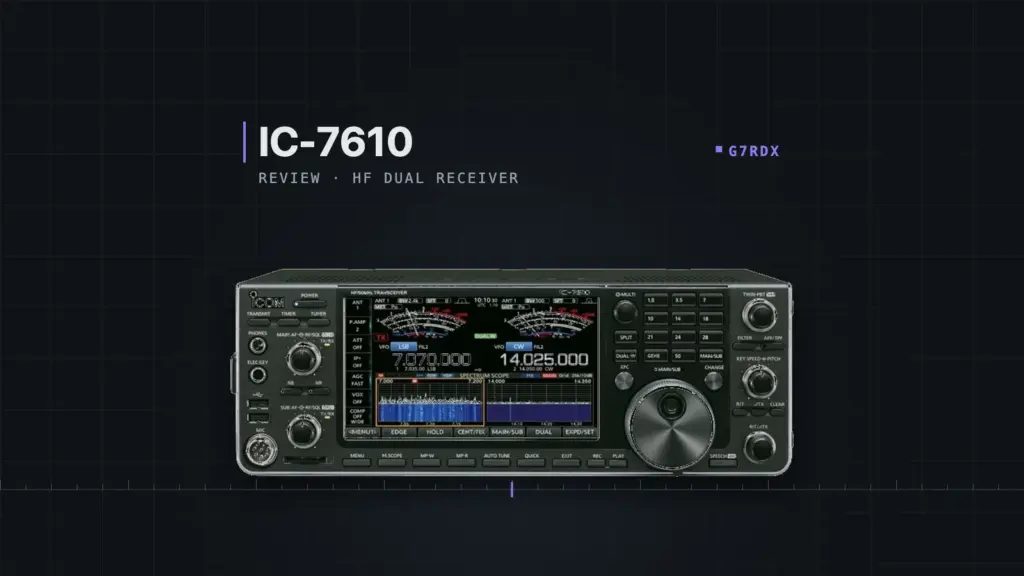
The Icom IC-7610 is the radio I use for HF contests and DX. HF means the short wave bands, where signals bounce off the sky and cross oceans. DX means a contact with a station far away. The IC-7610 has two identical receivers, a 7 inch touchscreen and a receiver Rob Sherwood ranked in his top ten.
It reached UK dealers in January 2018. Icom UK’s target price then was £2,999.99 before VAT. Eight years on it sells at £3,199.99 and Icom has announced no successor. This page explains what the two receivers do, what DPD is, what went wrong with some early screens, and the firmware history to version 1.45. It also gives UK prices in September 2026 and compares the 7610 with the IC-7300MK2, the IC-7760 and the Yaesu FTDX10 and FTDX101D.
In short. The Icom IC-7610 is a 100 W HF and 6m transceiver with two independent RF direct sampling receivers, a 7 inch dual-scope touchscreen, built-in LAN remote and I/Q output. UK price in September 2026 is £3,199.99 new with a free SP-41 speaker and SM-30 microphone at ML&S, and about £2,100 used. Buy it for contesting, split-frequency DX and diversity reception. Buy the IC-7300MK2 instead if you never need a second receiver.
Jump to: What is the Icom IC-7610? · Is the IC-7610 an SDR radio? · Icom IC-7610 specifications · What do the two receivers do in a real contest? · How good is the IC-7610 receiver? · What is DPD and does the IC-7610 have it? · IC-7610 firmware history · Known issues: screen retention, heat, remote dropouts · Icom IC-7300 vs IC-7610: is the upgrade worth it? · IC-7610 or Yaesu FTDX101D, and which is better, Icom or Yaesu? · What is the price of the Icom IC-7610 in the UK? · Is there an IC-7610 successor? · Who should buy the Icom IC-7610? · Frequently asked questions
What is the Icom IC-7610?
The Icom IC-7610 is an HF and 50 MHz radio with two complete receivers and one 100 W transmitter. The receiver is the part of the radio that listens. The transmitter is the part that talks.
Most radios have one receiver, so you listen to one frequency at a time. The IC-7610 has two, and they are identical. This is called a dual receiver. Each has its own DIGI-SEL preselector, band-pass filters and analogue-to-digital converter. A preselector is a tuned filter that lets your band through and blocks the others. An analogue-to-digital converter, or ADC, turns the radio wave into numbers. Both sets of numbers go into a single FPGA, a chip which does the maths.
Icom showed the radio at Ham Fair Tokyo in August 2016. It shipped in the UK in January 2018 as the replacement for the IC-7600. The transmitter is the familiar Icom 100 W stage with solid-state transmit-receive switching. Solid-state means no mechanical relay, so there is no click each time you press the key. CW operators who use QSK, where the radio listens between every dot and dash, notice this at once.
Is the IC-7610 an SDR radio?
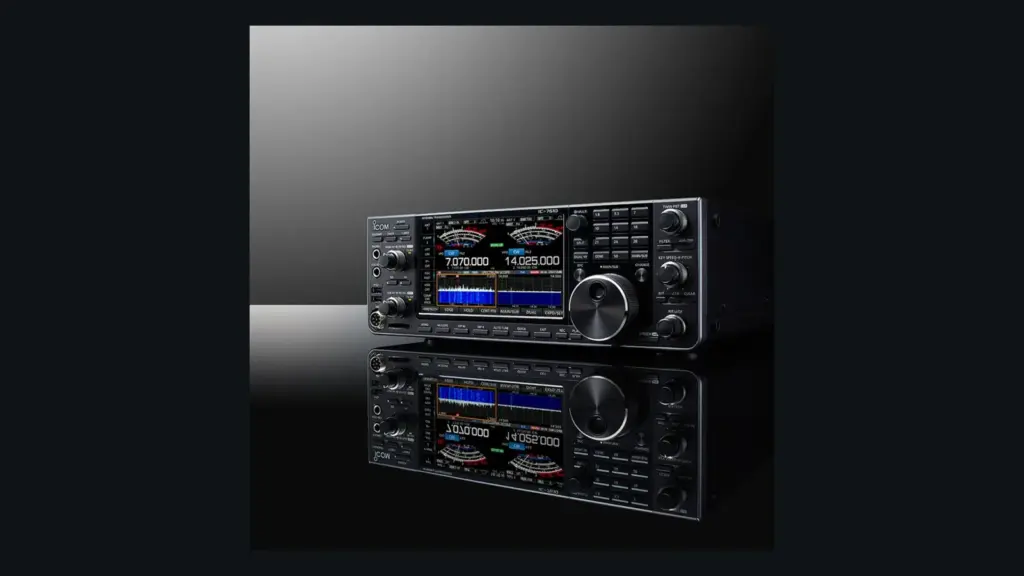
Yes. The Icom IC-7610 is an SDR, a software defined radio, of the direct sampling type. In an SDR, most of the work of picking out a signal is done by a computer chip running software, not by coils and crystals.
Direct sampling means the ADC digitises the whole HF spectrum straight from the antenna. There is no stage that shifts the signal to a lower frequency first, as older radios do. The FPGA then filters the numbers down to the one signal you want.
Because the radio already has the whole band as numbers, it can draw the spectrum scope. That is the picture where every signal is a spike and the waterfall shows the last few seconds of history. It can also send the raw numbers to a PC. That stream is the I/Q output, explained in the specifications section below.
Yaesu’s FTDX10 and FTDX101D use an older SDR design called hybrid. It mixes the signal down to a lower frequency first and then digitises it. Both designs work well. Direct sampling gives Icom two full receivers on one chip, and that is what the IC-7610 is built around.
Icom IC-7610 specifications
The Icom IC-7610 gives 1 to 100 W from 160m to 6m and has two direct sampling receivers. It weighs 8.5 kg and draws 23 A on transmit.
| Feature | Icom IC-7610 |
|---|---|
| Bands (TX) | 160m to 6m including WARC bands (60m on US version) |
| RX coverage | 30 kHz to 60 MHz |
| Modes | USB, LSB, CW, RTTY, PSK31/63, AM, FM |
| Power | 1 to 100 W. AM 1 to 25 W |
| Receivers | Two independent RF direct sampling receivers, two DIGI-SEL preselectors, two ADCs |
| RMDR | 110 dB at 2 kHz (Icom). Sherwood measured 112 dB |
| Two-tone dynamic range | 98 dB at 2 kHz with IP+ on (Sherwood). 101 dB (QST lab) |
| Display | 7 inch colour touchscreen, 800 x 480, dual spectrum scopes and waterfalls |
| External display | DVI-D, 800 x 480 or 800 x 600 |
| Internal ATU | 1.9 to 50 MHz, 16.7 to 150 Ω |
| Connectivity | LAN (built-in RS-BA1 server), USB 1 with two virtual COM ports, USB 2 with I/Q output, SD card, BNC RX IN/OUT, two SO-239 antenna sockets, ACC |
| CI-V address | 98h |
| Decoders | RTTY and PSK decode and transmit without a PC, CW keyer with serial numbers |
| Audio | Over 2 W into 8 Ω |
| Power supply | 13.8 V DC, 23 A on transmit, 3.0 A receive standby |
| Size and weight | 340 x 118 x 277 mm. 8.5 kg (Icom America) or 8.8 kg (Icom Japan) |
| Latest firmware | 1.45, 5 December 2025 |
A few of these words need unpacking. WARC bands are three extra HF bands, 30m, 17m and 12m, where contests are not allowed. An ATU is an antenna tuning unit, which makes a slightly wrong antenna look right to the transmitter. DVI-D is the plug used by computer monitors, so you can put the scope on a big screen on the desk. CI-V is Icom’s control language, and 98h is the address a PC uses to talk to this radio. I/Q output is the raw digitised band sent over USB 2 to a PC at 1.92 MHz sampling and 1.66 MHz bandwidth. Software such as HDSDR or CW Skimmer can then decode every CW signal on the band at once.
Icom Japan quotes 8.8 kg and Icom America 8.5 kg for the same radio. Dealers in the UK quote the RMDR as 105 dB at 1 kHz, Icom as 110 dB at 2 kHz. The dealers quote a different spacing. Icom’s own figure is 110 dB at 2 kHz.
What do the two receivers do in a real contest?
The two receivers are the reason the Icom IC-7610 exists. Here is how they earn their keep on a contest weekend.
In a CW or SSB contest you run on one frequency with the main receiver. Running means calling CQ on your own frequency and working whoever answers. At the same time the sub receiver searches the band in your other ear. This is called SO2V, single operator two VFOs. A VFO is the tuning dial, and this radio has two. When a multiplier appears on the sub, you pounce, work it and go back to running. A multiplier is a station that adds more to your score than a normal contact. The two scopes on the screen show both frequencies at once.
On split-frequency DX, the rare station transmits on one frequency and listens on another. Hundreds of stations call on the listening frequency, and that crowd is the pile-up. The main receiver sits on the DX station and the sub on the pile-up. You hear who the DX is working and where the next station up will be. A single-receiver radio makes you guess the pile-up frequency. The IC-7610’s second receiver shows it.
Diversity reception puts both receivers on the same frequency with two different antennas, say a Yagi and a vertical. Each antenna hears the noise slightly differently. One goes in each ear and your brain does the rest. Owners on 160m and 80m report copying signals in noise which one antenna alone cannot deliver. The optional RC-28 encoder adds a physical knob for the sub VFO, which contesters recommend.
The CW keyer stores messages with an auto-incrementing serial number. RTTY runs from the front panel with the built-in decoder, or through N1MM+ with FSK keyed on the second USB COM port, so no external interface is needed. See the Contest Calendar for the weekends where this pays off.
How good is the IC-7610 receiver?
The Icom IC-7610 receiver is one of the best Icom has built. Rob Sherwood’s 2023 Contest University slides rank it seventh of the top 25 transceivers.
Sherwood Engineering tested the IC-7610 in December 2017. The noise floor came out at minus 125 dBm. The noise floor is the quietest signal the radio can hear, and lower is better. Two-tone dynamic range measured 90 dB with IP+ off and 98 dB with IP+ on at 2 kHz spacing. Dynamic range is how strong a signal next door can be before it spoils the weak one you want. Sherwood ranks radios on this number. Reciprocal mixing dynamic range, or RMDR, came out at 112 dB. RMDR tells you how much a strong signal nearby raises the noise you hear, because of tiny wobbles in the radio’s own oscillator. Blocking dynamic range was 124 dB. Blocking is when a strong signal makes the receiver go deaf.
In Sherwood’s 2023 list the IC-7610 sits at 98 dB, behind the FTDX101D at 110 dB and the FTDX10 at 107 dB, and ahead of the IC-7300 at 97 dB. The QST lab review of 2018 measured 101 dB two-tone dynamic range and 113 dB RMDR. VA7OJ found birdies only below 500 kHz and an unwanted transmit signal on 6m one decibel over the international limit. Birdies are false signals a radio makes inside itself.
At the desk this means the IC-7610 keeps receiving when a big signal sits 2 kHz away. The noise floor with the preamp off is low enough for 160m. The FTDX10 beats it on close-in dynamic range at well under half the price, but with one receiver and a 5 inch screen.
IP+ is a setting that makes the ADC more tolerant of strong signals. It adds about 3.5 dB to the noise floor, so switch it on in contests and off when chasing weak DX.
What is DPD and does the IC-7610 have it?
DPD stands for Digital Pre-Distortion. Firmware 1.41 in May 2024 added it to the Icom IC-7610.
Every transmitter bends the signal a little, and that bend spreads energy outside your channel. Your neighbours hear it as splatter. With DPD the radio samples its own output through the internal monitor and works out the bend. It then bends the signal the opposite way before it leaves, and the two bends cancel. In barefoot mode, which means the radio on its own with no amplifier, it corrects the transmitter. With the IC-PW2 amplifier and the OPC-2501 cable it corrects the amplifier as well.
On a neighbouring station’s scope the result is a tighter SSB signal and cleaner FT8 with less energy outside the passband. Firmware 1.44 fixed a tuning failure of the internal ATU with DPD on. If you run the radio barefoot into a clean antenna, switch DPD on and leave it.
IC-7610 firmware history
The latest IC-7610 firmware is 1.45 from 5 December 2025. Icom added DPD in version 1.41 in May 2024.
| Version | Date | What changed |
|---|---|---|
| 1.30 | 2021 | Scope scroll mode, four fixed edges per band, per-band reference level, settings kept after update, 0.1 dB reference steps |
| 1.41 | May 2024 | DPD in barefoot and amplifier mode, IC-PW2 linkage, improved all-reset |
| 1.42 | June 2024 | Fixed HDSDR I/Q communication error on USB 2 |
| 1.44 | September 2025 | Network name character restriction, fixed ATU tuning failure with DPD on |
| 1.45 | December 2025 | Fixed RTTY and PSK decode text colour bug |
Firmware is the software inside the radio, updated from an SD card. Units on firmware 1.05 or earlier must update to 1.06 before jumping to a current version. Firmware 1.45 on a radio designed in 2016 is why the 7610 still feels current. Sub-CPU 1.07, front panel 1.01 and FPGA 1.12 ship with it.
Known issues: screen retention, heat, remote dropouts
The Icom IC-7610 has one well-known fault, and it is the screen. Certain early production runs used 7 inch panels that showed image ghosting after long use with a static display.
Ghosting, or image retention, is a faint copy of the old picture that stays on the screen after it changes. Icom America ran a warranty display replacement programme from March 2020 with a new panel supplier and a $100 certificate for affected owners. A groups.io list called IC-7610-Defects tracks reports. Buying used, run the radio for an hour on the scope, then switch to a plain menu screen and look for ghosting.
The fan is thermally controlled and often runs at low speed in receive. Most owners describe it as inaudible and quieter than the IC-7300’s. Remote operation dropouts over wfview and RS-BA1 come up on the forums. The threads point to the home router, not the radio.
Across 84 eHam reviews the praise goes to the display, the dual receivers and the noise reduction. The complaints are screen failures on 2019 units, menu logic and a maximum audio volume some hearing-impaired operators find low. In 2025 a hardware revision known as version 32 appeared in the USA at a $600 higher price. Icom’s Ray Novak was reported to have said the rise was mostly tariffs, with a small part for replaced components and no new features.
Icom IC-7300 vs IC-7610: is the upgrade worth it?
The upgrade from an IC-7300 to an IC-7610 is worth it if you need the second receiver. If you do not, it is £1,840 you could spend on an antenna.
The IC-7610 gives you two independent direct sampling receivers, a 7 inch dual-scope touchscreen, a DVI-D output, I/Q output over USB, built-in LAN remote and a BNC RX antenna in and out. The IC-7300MK2 gives you one receiver, a 4.3 inch screen, 4m (70 MHz) at 50 W and a newer front end, for £1,359. The IC-7610 does not cover 4m. Sherwood measured the original IC-7300 at 97 dB and the IC-7610 at 98 dB, so the receivers are close on paper. The difference is the second receiver, the screen and the connections, not the raw numbers.
If you run contests with SO2V, work split pile-ups or use two antennas on the low bands, the second receiver pays for itself every weekend. If not, the IC-7300MK2 covers your operating and the balance buys a better antenna.
IC-7610 or Yaesu FTDX101D, and which is better, Icom or Yaesu?
Neither brand is better across the board. On receiver numbers Yaesu wins in this price bracket. On screen, remote operation and software support Icom wins. Here are the five radios side by side.
| IC-7610 | IC-7300MK2 | IC-7760 | Yaesu FTDX10 | Yaesu FTDX101D | |
|---|---|---|---|---|---|
| UK price, Sept 2026 | £3,199.99 | £1,359 | £5,074.99 (list £5,339) | £1,299 | £3,099.95 |
| Power | 100 W | 100 W | 200 W | 100 W | 100 W |
| Receivers | Two, direct sampling | One, direct sampling | Two, direct sampling | One, hybrid SDR | Two, hybrid SDR |
| Two-tone DR (Sherwood) | 98 dB | Not yet tested | Not yet tested | 107 dB | 110 dB |
| Display | 7 inch touch, dual scope | 4.3 inch IPS | 7 inch plus 2.4 inch, separate head | 5 inch | 7 inch |
| LAN remote | Built in | Built in | Built in, head over LAN | Optional SCU-LAN10 | Optional SCU-LAN10 |
| 4m (UK) | No | Yes, 50 W | No | Yes | Yes |
| Launched | 2017 (UK January 2018) | 2025 | 2024 | 2020 | 2018 |
The FTDX101D costs £100 less than the IC-7610 and has two receivers too. Sherwood measured it at 110 dB against 98 dB, so Yaesu has the better receiver numbers. The IC-7610 has the touchscreen, built-in LAN remote with no extra box, I/Q output and CI-V, which most logging and contest software speaks. So the choice comes down to ecosystem, the Icom touchscreen and the software you already run.
Against the IC-7760, the flagship adds 200 W, a separate control head over LAN and newer chips inside for £1,875 more. The FTDX10 is the value pick if one receiver is enough: 107 dB dynamic range for £1,299. If you contest seriously, the second receiver on the 7610 is worth the difference every weekend.
What is the price of the Icom IC-7610 in the UK?
On 2 September 2026 the Icom IC-7610 costs £3,199.99 at Martin Lynch & Sons, in stock with a free SP-41 speaker and SM-30 microphone. Nevada Radio and Moonraker are £3,199.95, against a £3,499.95 recommended price.
In the USA Ham Radio Outlet lists the version 32 at $3,899.95, while DX Engineering was tracked at $3,399.
Used IC-7610s do come up for sale. ML&S had a boxed example at £2,099, down from £2,250, and Nevada listed a B-grade unit at £2,862, now sold. Expect £2,000 to £2,300 for a clean private sale. Check the display for ghosting, confirm firmware 1.45, and ask for the original box. The radio weighs 8.5 kg and travels badly without it.
Still unknown on 2 September 2026. Whether Icom plans an IC-7610 successor. Sherwood test data for the IC-7300MK2 and IC-7760 to compare with. Whether the version 32 revision will reach the UK under that name.
Is there an IC-7610 successor?
No. Icom lists the IC-7610 as current in Japan, the UK and the USA. It released firmware 1.45 in December 2025 and added support for the new SP-41 speaker and RC-28 version 2.
The IC-7760 launched in 2024 above it, not in its place. The IC-7110 announced in August 2026 is a mobile radio which sits between the IC-7300MK2 and the 7760. If Icom announces a 7610 replacement I will update this page the same day.
Who should buy the Icom IC-7610?
Buy the Icom IC-7610 if you contest with SO2V, chase DX in split pile-ups, use diversity reception on the low bands, or want an I/Q output for CW Skimmer on the same radio you transmit with. The dual receivers and the 7 inch screen are the reasons it exists, and nothing at £3,200 does both.
Buy the IC-7300MK2 if one receiver covers your operating, and put the £1,840 difference into an antenna. Buy the FTDX10 if raw receiver numbers matter more than a second receiver. Buy the FTDX101D if you want two receivers and prefer Yaesu’s knobs to Icom’s touchscreen.
Before a contest weekend, check the Propagation Score and the DX Cluster to see which bands are open.
Questions about the IC-7610? Leave a comment below, or find me on QRZ, Facebook (facebook.com/G7RDX) and YouTube (@g7rdx).
73 de G7RDX
Frequently asked questions
What is the price of the Icom 7610 in the UK?
The Icom IC-7610 costs £3,199.99 at Martin Lynch & Sons on 2 September 2026, with a free SP-41 speaker and SM-30 microphone. Nevada Radio and Moonraker list it at £3,199.95 against a recommended price of £3,499.95. Used examples sell for £2,000 to £2,300. Icom UK’s 2017 target price was £2,999.99 before VAT.
Is the Icom 7610 a SDR radio?
Yes. The Icom IC-7610 is a direct sampling software defined radio. Its two receivers each digitise the whole HF band straight from the antenna with a 16 bit converter, and an FPGA chip does the filtering in software. That is why it can draw two spectrum scopes and send an I/Q stream to a PC.
Which radio is better, Icom or Yaesu?
Neither brand wins outright. Yaesu’s FTDX10 and FTDX101D measure better on Sherwood’s dynamic range test, 107 dB and 110 dB against 98 dB for the Icom IC-7610. Icom gives you the touchscreen, built-in LAN remote, I/Q output and CI-V control that most logging software supports. Pick the one whose controls and software suit how you operate.
Which radio is better, the Icom 7610 or the Yaesu FTDX-101D?
The Yaesu FTDX101D costs £3,099.95, has two hybrid SDR receivers and measures 110 dB two-tone dynamic range. The Icom IC-7610 costs £3,199.99, has two direct sampling receivers, measures 98 dB and adds a touchscreen, I/Q output and LAN remote with no extra box. Yaesu wins on numbers. Icom wins on screen, remote and software.
Icom IC-7300 vs 7610, worth the upgrade?
The IC-7610 upgrade is worth it if you need two receivers for SO2V contesting, split pile-ups or diversity reception. The IC-7610 adds a second receiver, a 7 inch dual-scope screen, DVI-D, I/Q output and built-in LAN for about £1,840 more than an IC-7300MK2. If one receiver is enough, keep the 7300 and buy a better antenna.
Is there a used Icom 7610 available for sale?
Yes. Used IC-7610s appear at UK dealers and in private sales. On 2 September 2026 ML&S had a boxed example at £2,099, down from £2,250, and Nevada had sold a B-grade unit at £2,862. Expect £2,000 to £2,300 privately. Check the screen for ghosting, confirm firmware 1.45 and ask for the original box.
Is the Icom IC-7610 still worth buying in 2026?
Yes, if you need two receivers. The Icom IC-7610 remains current, received firmware 1.45 in December 2025 and has no announced successor. At £3,199.99 new or about £2,100 used it is the cheapest dual-receiver direct sampling radio from Icom. If one receiver is enough, the IC-7300MK2 at £1,359 is the better buy.
IC-7610 or IC-7760?
The Icom IC-7760 costs £5,074.99, gives 200 W, a separate control head connected over LAN, dual 7 inch and 2.4 inch displays and newer components. The IC-7610 gives 100 W and two receivers for £3,199.99. Choose the 7760 for a remote-head installation or 200 W. The 7610 covers every other contest and DX task.
IC-7610 or Yaesu FTDX10?
The Yaesu FTDX10 costs £1,299 and measures 107 dB two-tone dynamic range against 98 dB for the Icom IC-7610, but has one receiver and a 5 inch screen. The IC-7610 has two identical receivers for SO2V, split DX and diversity, a 7 inch screen and I/Q output. Pick by whether you need the second receiver.
Does the IC-7610 have DPD?
Yes. The Icom IC-7610 gained Digital Pre-Distortion in firmware 1.41 from May 2024. In barefoot mode it uses the internal monitor to linearise the transmitter. In amplifier mode it corrects the IC-PW2 through the OPC-2501 cable. Firmware 1.44 fixed an ATU tuning failure with DPD enabled.
What is the latest IC-7610 firmware?
The latest Icom IC-7610 firmware is version 1.45, released on 5 December 2025, which fixes an RTTY and PSK decode text colour bug. It includes sub-CPU 1.07, front panel 1.01 and FPGA 1.12. Radios on firmware 1.05 or earlier must update to 1.06 first.
Does the IC-7610 have screen burn-in problems?
Some Icom IC-7610 units built between 2018 and 2020 showed image retention on the 7 inch display. Icom America ran a warranty replacement programme from March 2020 with a new panel supplier and a $100 certificate for affected owners. When buying used, run the scope for an hour then check a plain menu screen for ghosting.
Can the IC-7610 receive two bands at once?
Yes. The Icom IC-7610’s two receivers are identical, so the sub receiver can sit on any band or on the same frequency as the main receiver. Dualwatch lets you monitor two bands, run SO2V in contests, listen to both sides of a split pile-up, or use two antennas on one frequency for diversity reception.
Can I run the IC-7610 remotely?
Yes. The Icom IC-7610 has a built-in RS-BA1 server on its LAN port, so no PC is needed in the shack. Icom’s RS-BA1 version 2 software or the free wfview application connects over the home network or the internet. Dropouts reported on forums trace to router settings rather than the radio.
How heavy is the IC-7610 and what power supply does it need?
The Icom IC-7610 weighs 8.5 kg by Icom America’s figure and 8.8 kg by Icom Japan’s, at 340 x 118 x 277 mm. It draws 23 A at 100 W transmit and 3.0 A on receive standby. A 25 A linear or switch-mode power supply is the minimum, and 30 A gives headroom. Its CI-V address is 98h.
Is the IC-7610 too much radio for a first HF station?
It is more radio than a first station needs, and that is not the same as a mistake. The second receiver and the spectrum scope are the things you grow into rather than start with. If the budget is fixed, the honest answer is that money spent on the antenna and on getting it higher will do more for your first year than the step up from a 7300.