Last updated: 2 September 2026. Prices checked at UK dealers on this date. ID-52E PLUS firmware 1.13 and ID-52E firmware 1.26 are current.
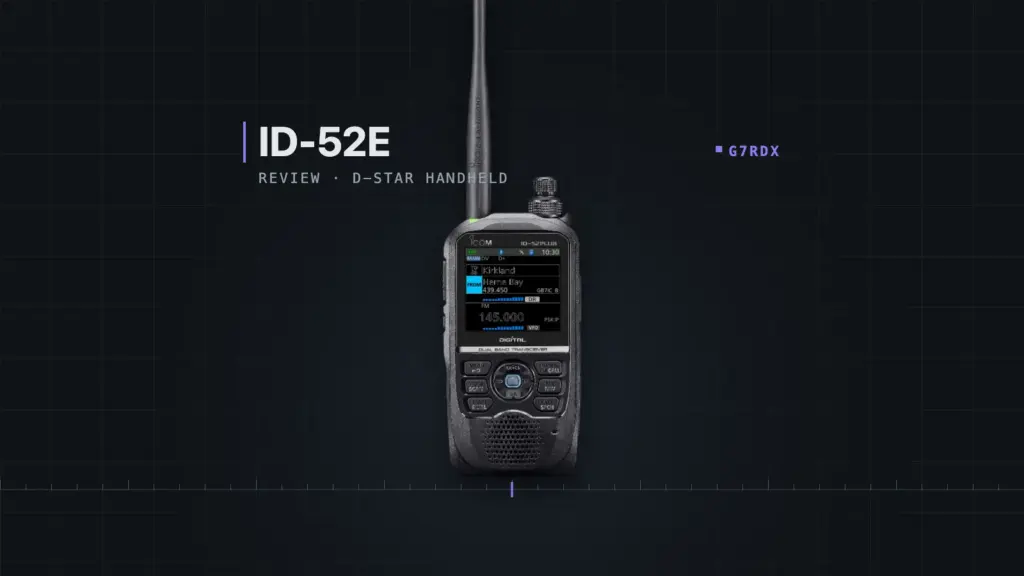
The Icom ID-52E is the D-STAR handheld I own, and the radio I use with my Pi-Star hotspot at home. A handheld is a radio you hold in one hand, like a walkie-talkie. D-STAR is a way of sending your voice as digital data instead of a plain analogue signal. It lets a small radio reach the internet and talk to people anywhere in the world.
Icom launched the ID-52E in 2020 to replace the ID-51E, and gave it a colour screen, Bluetooth and a proper loudspeaker. In 2024 Icom replaced it with the ID-52E PLUS, and Icom UK now lists the original as discontinued. This article explains what the ID-52E does, what the PLUS changed, the settings for a hotspot and the reflector commands. It also covers real battery life, UK prices in September 2026, and how it compares with the Kenwood TH-D75E and the cheaper Icom ID-50E.
In short. The Icom ID-52E is a 5 W dual-band D-STAR and FM handheld with a 2.3 inch colour display, GPS, Bluetooth, IPX7 waterproofing and airband receive. The original is discontinued. The ID-52E PLUS (£499 at ML&S in September 2026) adds Bluetooth 5.3 for wireless Terminal mode, USB-C, and Terminal mode and normal radio use at the same time. Used originals are listed at £360 to £450. Buy the PLUS new, or a used original if you use a hotspot and never Terminal mode.
Jump to: What is the Icom ID-52E? · Icom ID-52E specifications · ID-52E vs ID-52E PLUS: what changed and does it matter? · How do you use the Icom ID-52E with a Pi-Star or WPSD hotspot? · What are Terminal mode and Access Point mode? · How long does the ID-52E battery last? · What are the known problems with the ID-52E? · Which firmware is the ID-52E on? · ID-52E PLUS vs Kenwood TH-D75E vs Icom ID-50E vs Yaesu FT-5DE · How much does the Icom ID-52E cost in the UK in September 2026? · Who should buy the Icom ID-52E? · Frequently asked questions
What is the Icom ID-52E?
The Icom ID-52E is a dual-band handheld radio for D-STAR digital voice and analogue FM. It is the European version of the ID-52A sold in the USA, and the two radios differ only in the frequencies they are allowed to transmit on.
Dual-band means it works on two amateur bands, 144 MHz (the 2 metre band) and 430 MHz (the 70 centimetre band). A band is a slice of radio frequencies which licensed amateurs may use. FM is the ordinary analogue voice mode, the same idea as an FM broadcast station, and every VHF handheld can do it. D-STAR adds the digital side, and with it the internet.
Icom announced the ID-52E on 7 August 2020 as the replacement for the ID-51E, which had been the standard D-STAR handheld since 2012. Over the ID-51E it brought a 2.3 inch colour transflective display in place of a 1.7 inch monochrome one, and 750 mW of audio instead of 400 mW. It added Bluetooth as standard, USB charging and UHF military airband reception. It also decodes two D-STAR signals at once, shares pictures and is waterproof to IPX7. A transflective display uses daylight to light itself, so it stays readable outdoors. IPX7 means the radio survives a drop into one metre of water for 30 minutes.
The batteries and microphones carried over from the ID-51, which matters if you own the older radio.
The E version transmits on 144 to 146 MHz and 430 to 440 MHz. The A version covers 144 to 148 and 430 to 450 MHz and adds US weather channels. Everything else is the same hardware, so if you searched for the ID-52A and the ID-52A PLUS, every answer on this page applies to your radio too.
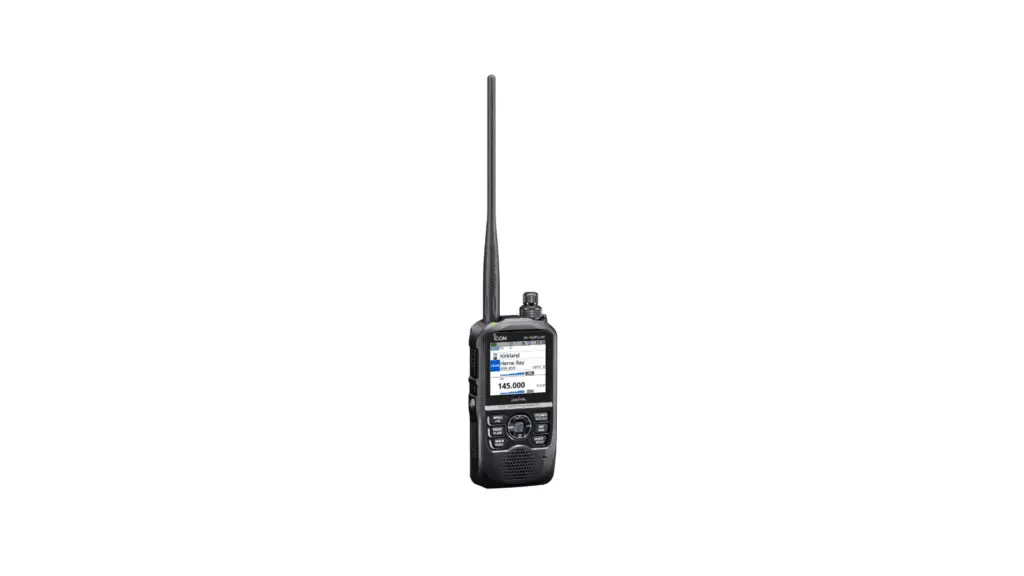
Icom ID-52E specifications
The Icom ID-52E and the ID-52E PLUS share the same transmitter, display, battery, GPS and audio. The table below lists every specification and marks the three rows where the PLUS differs.
| Feature | Icom ID-52E | Icom ID-52E PLUS |
|---|---|---|
| Bands (TX) | 144 to 146, 430 to 440 MHz | Same |
| RX | 108 to 174 and 225 to 479 MHz (version dependent), plus separate FM broadcast receiver | Same |
| Airband | VHF airband AM and UHF military airband 225 to 375 MHz | Same |
| Power | 5 / 2.5 / 1 / 0.5 / 0.1 W | Same |
| Current and supply | Under 2.5 A at 5 W on the battery, 10 to 16 V DC through the external jack | Same |
| Modes | DV, FM, FM narrow. RX adds WFM, AM | Same |
| Display | 2.3 inch transflective colour, 320 x 280 | Same |
| Dualwatch | V/V, U/U, V/U and DV/DV | Same |
| GPS | Built in, D-PRS, grid square, nearest repeater search, GPS logging | Same |
| Bluetooth | Yes, headset and app control. Terminal mode needs a cable | Bluetooth 5.3, Terminal and Access Point mode wireless to Android, iOS from firmware 1.10 |
| Terminal plus RF at once | No | Yes |
| USB | Micro-USB | USB-C |
| microSD | Slot, up to 32 GB (256 GB SDXC from firmware 1.26 / 1.10) | Same |
| Waterproof | IPX7, 1 m for 30 minutes | Same |
| Battery | BP-272, 7.4 V 2,000 mAh typical, supplied. BP-307 3,350 mAh optional | Same |
| Battery life (Icom) | 7.25 hours FM with BP-272, 12 hours with BP-307 | Same |
| Audio | Over 750 mW | Same |
| Memories | 1,000 channels, 2,500 repeaters, 500 broadcast stations | Same |
| Size and weight | 61.1 x 121.6 x 34.8 mm with battery, 330 g with antenna | Same |
| Latest firmware | 1.26, November 2024 | 1.13, January 2026 |
| UK price, Sept 2026 | Discontinued. Last dealer price £519.95, used asking £360 to £450 | £499 to £499.95 |
A few words from the table need explaining. TX is transmit, the part of the radio that talks, and RX is receive, the part that listens. DV is Icom’s name for D-STAR digital voice. Dualwatch means the radio listens on two frequencies at once, so DV/DV means two D-STAR signals together. D-PRS sends your GPS position over D-STAR so it shows on a map, and a grid square is a short code for where you are, used by amateurs instead of a postcode.
The RigPix listing gives the FM broadcast receiver a lower edge of 76 MHz while Icom America lists 88 MHz for the A version. The E version manual settles it for your unit, and in the UK it makes no difference. The 34.8 mm in the table is with the battery fitted.
ID-52E vs ID-52E PLUS: what changed and does it matter?
The ID-52E PLUS changes three things: Bluetooth 5.3 for wireless Terminal mode, a USB-C socket, and Terminal mode and normal radio use at the same time. The transmitter, display, battery, GPS and audio are the same as the original ID-52E.
Icom announced the ID-52E PLUS in July 2024 and shipped it in summer 2024. A 60th anniversary limited edition of 2,400 units worldwide came in a titanium-look metallic finish at £619.99. The standard PLUS costs £499 in September 2026.
The first change is a new Bluetooth 5.3 module. It lets the PLUS run Terminal mode and Access Point mode wirelessly with an Android phone running the RS-MS3A app, and with iOS since firmware 1.10. The original needs a USB cable to the phone or PC.
The second change is the socket. The micro-USB socket became USB-C, used for charging, programming with the CS-52PLUS software and CI-V control. CI-V is Icom’s way of letting a computer control the radio. The third change is that the PLUS can run Terminal mode and normal simplex or repeater operation at the same time, where the original does one or the other. Simplex means two radios talking directly on one frequency. A repeater is a big radio on a hill or a tall building which hears weak signals and sends them out again at higher power.
The RF side, power, display, battery, GPS and audio are unchanged. The comparison tables on the Martin Lynch & Sons and Icom Europe pages confirm it. For a hotspot user the changes make little practical difference, which is why one RadioReference reviewer called the PLUS a minor upgrade. If you want to reach a reflector from a hotel room with your phone as the link, the wireless Terminal mode of the PLUS is worth £100 over a used original. If you have a Pi-Star at home and use the radio over the air, a used original at £400 does the same job.
How do you use the Icom ID-52E with a Pi-Star or WPSD hotspot?
The Icom ID-52E works with a Pi-Star or WPSD hotspot once the memory channel is set to duplex with a zero offset and the four callsign fields are filled in. Most setup problems come from one of those two things.
A hotspot is a small box, usually a Raspberry Pi computer with a tiny radio board on top, which links your handheld to the D-STAR network over your home internet. Pi-Star is the free software which runs on that box. WPSD is a newer version of the same idea with a different look. The hotspot hears your radio from a few metres away, and everything after that travels over the internet.
The ID-52E expects to find D-STAR on repeaters. A repeater listens on one frequency and talks on another, and the gap between the two is called the offset. Working that way is called duplex. A hotspot listens and talks on the same frequency, so the offset is zero, but the radio still needs to be told it is working duplex. Set DUP plus or minus with a 0.000 MHz offset. Leaving DUP off does not work.
Then fill in four callsign fields. A callsign is the name your licence gives you. MY CALL is your callsign. RPT1 is your hotspot callsign with the module letter B in the eighth position, for example G7RDX B. RPT2 is your hotspot callsign with G in the eighth position. UR CALL is CQCQCQ, which means “calling anyone”. D-STAR splits a repeater or hotspot into modules, each with a letter, and B is the usual letter for 70 cm. The letter G marks the gateway, the part which connects to the internet.
On the Pi-Star side, set the D-STAR module to B, enable ircDDBGateway, the part of Pi-Star that links to reflectors, set your default reflector and choose Startup or Manual linking. Give the RF and network hang times at least five seconds. Hang time is how long the hotspot waits after someone stops talking before it lets the other side speak.
A reflector is a server on the internet which joins many hotspots and repeaters into one big conversation, like a conference call. There are three families, REF, DCS and XLX. Each reflector has a number and several modules, each with a letter, so XLX585 module D is one room inside reflector 585.
To link a reflector from the radio, put the command in the UR CALL field and press the transmit button (PTT) for a moment. XLX585DL links XLX585 module D, DCS001CL links DCS001 module C, REF030CL links REF030 module C. The letter U unlinks (XLX585U, or seven spaces followed by U) and seven spaces followed by I asks the reflector for its status. The WPSD manual has the full command list. I use Italian and UK XLX reflectors this way. More on the D-STAR side is in the Digital category.
What are Terminal mode and Access Point mode?
Terminal mode lets the ID-52E use a phone or PC as its own link to the D-STAR network, so you need no hotspot and no repeater. Access Point mode turns the ID-52E into a hotspot for a second D-STAR radio within range.
In Terminal mode the radio talks to a phone or PC running RS-MS3A (Android and iOS) or RS-MS3W (Windows), and the phone’s internet connection carries your voice to reflectors and repeaters worldwide. No hotspot hardware is needed.
Both modes need a D-STAR registration on a G3 gateway. A gateway is the computer at a D-STAR repeater which connects it to the internet, and G3 (RS-RP3C) is the current version of Icom’s gateway software. Your local D-STAR repeater keeper registers your callsign for you. On the original ID-52E the phone link is a cable, OPC-2350LU for Android or USB for Windows. On the PLUS it is Bluetooth. If you travel with the radio, this is the feature which sells the PLUS.
How long does the ID-52E battery last?
Icom quotes 7.25 hours on the supplied BP-272 battery in FM and 12 hours on the optional BP-307. In practice the ID-52E battery lasts longer with GPS and Bluetooth switched off and shorter if you transmit a lot.
The BP-272 holds 2,000 mAh and the BP-307 holds 3,350 mAh. mAh is a measure of how much charge a battery stores, and a bigger number means a longer day. One PLUS owner on RadioReference reported struggling to reach 10 hours with heavy use. Another called the battery life exceptional. Both are right for their pattern of use.
The BP-272 is shared with the ID-51, ID-31 and IC-705, so spares are cheap and plentiful. Charging is through the USB socket or the BC-202 desk charger. Switch GPS off when you are not using D-PRS and the battery lasts noticeably longer.
What are the known problems with the ID-52E?
The most common ID-52E complaints are the display in bright sun, the loose top knob, the deep microphone socket and the price. None of them stops the radio working, and the PLUS fixed the micro-USB socket.
The display is transflective, which helps outdoors, but it is not the brightest in direct sun and the contrast in some menus reads as light grey. The top knob, called the encoder, has weak clicks, so it is easy to change frequency when you meant to change volume. There is no numeric keypad, so you type a frequency with the small joystick instead.
The microphone and speaker socket is deeply recessed. Third-party headsets typically need a £24 adapter. The original’s micro-USB socket was called planned obsolescence by one eHam reviewer, and the PLUS fixes it.
On the PLUS, Icom acknowledged a firmware bug where AM mode cannot be selected between 375 and 380 MHz. Programming files made with RT Systems software for an ID-51 are not compatible with the ID-52E, and the SD card formats differ between the two models.
The price draws the most comments. At £499 the PLUS costs about £210 more than the ID-50E, which has the same transmitter and D-STAR but a mono display and no Bluetooth. eHam reviewers who accept the price say they pay for the screen, the audio and the Bluetooth.
Which firmware is the ID-52E on?
The ID-52E PLUS is on firmware 1.13 from January 2026, and the original ID-52E stopped at 1.26 in November 2024. Firmware is the built-in software inside the radio, and Icom UK publishes the updates and notes on its ID-52E PLUS page.
| Radio | Version | Date | What it did |
|---|---|---|---|
| ID-52E PLUS | 1.13 | January 2026 | Internal performance update, no change to operation (Icom UK) |
| ID-52E PLUS | 1.12 | Not stated | Changelog not published |
| ID-52E PLUS | 1.11 | Between 1.10 and 1.13 | Fixed a gateway callsign import bug |
| ID-52E PLUS | 1.10 | November 2024 | iOS support for Terminal and Access Point mode, memory scope, faster picture display, SDXC cards up to 256 GB |
| ID-52E | 1.26 | November 2024 | 256 GB SDXC support and a DV bit-sync fix |
Version 1.10 was the important one for the PLUS. Before it, wireless Terminal mode worked with Android only.
The original ID-52E has had no update since 1.26 in November 2024. No later version has appeared, which is the practical meaning of discontinued.
ID-52E PLUS vs Kenwood TH-D75E vs Icom ID-50E vs Yaesu FT-5DE
Of the four handhelds in this table, the ID-52E PLUS at £499 is the only D-STAR radio with both a colour screen and Bluetooth under £700. The Kenwood TH-D75E costs £240 more and adds APRS and HF receive, the ID-50E costs £210 less and drops the colour screen, and the Yaesu FT-5DE is a Fusion radio, not a D-STAR one.
| Icom ID-52E PLUS | Kenwood TH-D75E | Icom ID-50E | Yaesu FT-5DE | |
|---|---|---|---|---|
| UK price, Sept 2026 | £499 | £739.99 | £289.99 | £379.95 |
| Digital mode | D-STAR | D-STAR | D-STAR | C4FM (Fusion) |
| APRS | D-PRS only | Full APRS with TNC | D-PRS only | APRS |
| Display | 2.3 inch colour | Colour | Monochrome | Colour touchscreen |
| Bluetooth | 5.3 | Yes | No | Yes |
| Wideband RX | Airband, mil airband, FM broadcast | Airband plus SSB and CW HF | Airband | Airband |
| Waterproof | IPX7 | IP54/55 | IPX7 | IPX7 |
| USB | USB-C | USB-C | USB-C | USB (data and firmware) |
| Weight | 330 g | 340 g | 300 g | 282 g |
APRS is the older system for sending your position and short text messages over ordinary FM, and it needs a TNC, a small modem built into the radio. D-PRS does the position part over D-STAR instead, and gateways pass it to the same maps. C4FM, also called Fusion, is Yaesu’s own digital voice system. A Fusion radio and a D-STAR radio cannot talk to each other directly.
The TH-D75E is the radio for APRS with a built-in TNC and SSB receive, at about £240 more. The ID-50E is the ID-52E’s transmitter in a cheaper body without Bluetooth or a colour screen, and the right choice for a second D-STAR radio. The FT-5DE lives on the Fusion network, not D-STAR, so it is only a rival if you have not chosen a digital mode yet.
How much does the Icom ID-52E cost in the UK in September 2026?
The Icom ID-52E PLUS costs £499 at Martin Lynch & Sons and £499.95 at Moonraker and Waters & Stanton on 2 September 2026. A used original ID-52E is listed on eBay UK at £356 to £453.
The PLUS prices are down from £559.95. Icom Europe’s recommended price is €660.40. In the USA Ham Radio Outlet lists the ID-52A PLUS at $749.95 and GigaParts at $699.95.
The original ID-52E is discontinued. Nevada Radio’s last listing showed £519.95 against a £549.95 recommended price. Two dealer pages carry errors worth knowing: one lists the display as 3 inches (it is 2.3) and another says the PLUS has micro-USB (it has USB-C).
Still unknown on 2 September 2026. The Bluetooth version of the original ID-52E. The changelog for PLUS firmware 1.12. Whether Icom will fold the PLUS features into a future ID-52 MkII.
Who should buy the Icom ID-52E?
Buy the ID-52E PLUS if you want one D-STAR handheld for years. The colour screen, the loud audio and the wireless Terminal mode make it the best-equipped D-STAR handheld under £500.
Buy a used original ID-52E for £400 if you run a Pi-Star hotspot at home and do not need Terminal mode on the move. Buy the ID-50E if the budget stops at £300 and you can live without Bluetooth. Buy the TH-D75E if APRS with a real TNC matters more than the £240 difference.
If you are still deciding between D-STAR and Fusion, look at which repeaters and clubs are active where you live before you spend anything. UK Repeater Network lists them by mode.
For a base station with the same D-STAR features, a proper speaker and a spectrum scope, see the Icom IC-9700 review on this site. For the IC-7100 successor expected in the UK in 2027, with no date confirmed, see the Icom IC-7110.
Questions about the ID-52E or Pi-Star settings? Leave a comment below, or find me on QRZ, Facebook (facebook.com/G7RDX) and YouTube (@g7rdx).
73 de G7RDX
Frequently asked questions
Is the Icom ID-52E discontinued?
Yes. Icom UK lists the original ID-52E as discontinued and no longer available. It was replaced in summer 2024 by the ID-52E PLUS, which adds Bluetooth 5.3 wireless Terminal mode, USB-C and Terminal mode alongside normal radio use. Used ID-52E radios are listed at £360 to £450 in the UK.
What are the key differences between the Icom ID-52A and Icom ID-52A PLUS?
The Icom ID-52A is the US version of the ID-52E, so the differences are the same. The ID-52A PLUS has a Bluetooth 5.3 module which runs Terminal and Access Point mode wirelessly with an Android or iOS phone, a USB-C socket instead of micro-USB, and can run Terminal mode and normal radio use at the same time. Transmitter, display, battery, GPS and audio are identical.
What is the price of the Icom ID-52A?
The Icom ID-52A original is discontinued, like the ID-52E. In the USA the ID-52A PLUS sells for $749.95 at Ham Radio Outlet and $699.95 at GigaParts. In the UK the ID-52E PLUS costs £499 at Martin Lynch & Sons and £499.95 at Moonraker and Waters & Stanton on 2 September 2026. Used originals are listed at £356 to £453.
What are the specifications of the Icom ID-52 PLUS?
The Icom ID-52E PLUS transmits 5 W on 144 to 146 and 430 to 440 MHz in D-STAR and FM. It has a 2.3 inch 320 x 280 colour display, 750 mW audio, GPS, Bluetooth 5.3, USB-C, a microSD slot, IPX7 waterproofing and 1,000 memory channels. The BP-272 battery gives 7.25 hours in FM. It measures 61.1 x 121.6 x 34.8 mm and weighs 330 g.
Is Icom a good radio brand?
Yes. Icom is a Japanese maker which marked its 60th anniversary in 2024 with a limited edition of this radio. Its ID-51E was the standard D-STAR handheld from 2012, and D-STAR itself is the digital mode Icom radios use. Firmware updates for the ID-52E PLUS continued into January 2026, six years after the model line began.
How do I set up the ID-52E with a Pi-Star hotspot?
Program the ID-52E hotspot frequency as a duplex memory with DUP on and a 0.000 MHz offset. Set MY CALL to your callsign, RPT1 to your hotspot callsign with B in the eighth character, RPT2 to the hotspot callsign with G in the eighth character, and UR CALL to CQCQCQ. In Pi-Star enable D-STAR module B and ircDDBGateway.
How do I link a reflector from the ID-52E?
On the ID-52E, put the command in the UR CALL field and press PTT. For example, XLX585DL joins module D of XLX585 and REF030CL joins module C of REF030. XLX585U, or seven spaces followed by U, unlinks, and seven spaces followed by I requests the reflector status. Return UR CALL to CQCQCQ to talk.
What is Terminal mode on the ID-52E?
Terminal mode connects the ID-52E to the D-STAR network through a phone or PC running RS-MS3A or RS-MS3W, with no hotspot or repeater. Access Point mode makes the radio a hotspot for a second D-STAR handheld. Both need a D-STAR registration on a G3 gateway. The original uses a cable, and the PLUS uses Bluetooth.
How long does the ID-52E battery last?
The ID-52E runs for 7.25 hours in FM on the supplied BP-272 (2,000 mAh) and 12 hours on the optional BP-307 (3,350 mAh), according to Icom. With GPS and Bluetooth on and regular transmitting expect less. The BP-272 is shared with the ID-51, ID-31 and IC-705, so spare batteries are easy to find.
Is the ID-52E waterproof?
Yes. The ID-52E is rated IPX7, which means it survives immersion in one metre of water for 30 minutes. The Kenwood TH-D75E is rated IP54/55 only, so the ID-52E and ID-50E are the better choices for SOTA (Summits on the Air, operating from hilltops) and wet-weather portable use.
Does the ID-52E have APRS?
No. The ID-52E supports D-PRS, Icom’s position reporting over D-STAR, which appears on APRS maps through gateways, but it has no APRS TNC for the analogue APRS network. Operators who need full APRS choose the Kenwood TH-D75E, which has the TNC built in.
Does the ID-52E receive airband?
Yes. The ID-52E receives VHF airband in AM and the UHF military airband from 225 to 375 MHz, plus a separate FM broadcast receiver which plays while you monitor an amateur channel. Airband is receive only. The radio transmits on the amateur bands alone.
ID-52E PLUS or Kenwood TH-D75E?
The ID-52E PLUS costs £499, is IPX7 waterproof and covers D-STAR, D-PRS, Bluetooth and Terminal mode. The TH-D75E costs £739.99, has a full APRS TNC and receives SSB and CW on HF, but is rated IP54/55. Choose the Kenwood for APRS, the Icom for D-STAR at a lower price and better weather sealing.
What is the latest ID-52E firmware?
The ID-52E PLUS is on version 1.13 from January 2026, a performance update. Version 1.10 from November 2024 added iOS Terminal mode, a memory scope, which shows activity on your saved channels, and 256 GB SDXC support. The original ID-52E stopped at version 1.26 in November 2024, which added 256 GB SDXC support and a DV bit-sync fix.
Can the ID-52E do DMR?
No. The ID-52E supports D-STAR and analogue FM only. DMR is a different digital voice system, and BrandMeister and other DMR networks are not reachable from it. A Pi-Star hotspot can serve DMR and D-STAR at the same time, but the ID-52E only uses the D-STAR side.